Why Arm Balances Are Genuinely Harder for Tall Yogis (And How to Adjust)
Quick Answer: Longer arms and legs create a longer lever arm, so the same body weight requires more core and shoulder strength to lift and hold in poses like crow or side crow — the fix is adjusting hand placement and building lever-specific strength rather than assuming you’re ‘just not flexible enough.’
Your shorter classmate floats into crow pose while you’re still negotiating with gravity. It’s not a flexibility gap — it’s leverage.
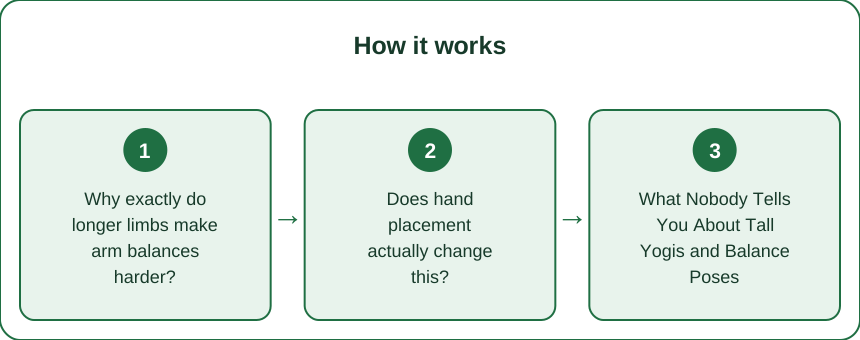
Why exactly do longer limbs make arm balances harder?
In poses like crow, your body weight is balanced over your hands like a lever, and a longer torso and legs mean that weight sits farther from the pivot point — physics requires more force to lift and control a longer lever than a shorter one, even at identical body weight.
Does hand placement actually change this?
Yes — placing hands slightly wider than shoulder width, fingers spread wide, gives a tall frame a broader, more stable base to distribute that longer lever’s weight across, rather than trying to balance on a narrow point built for a shorter reach.
What Nobody Tells You About Tall Yogis and Balance Poses
Most yoga cues are demonstrated by instructors of average height, so the visual reference you’re copying often doesn’t match your own proportions. Tall practitioners typically need to bend the knees more and tuck closer to the chest in poses like crow to shorten their effective lever arm — this isn’t a modification, it’s the correct form for your body, even if it looks different from the demo.
What strength work actually helps most?
Core-to-shoulder integration work — like plank holds with a knee tap, or slow scapula push-ups — builds the specific stability needed to control a longer lever, more directly than general strength training.
FAQ: Tall Yoga Arm Balance Questions, Answered
Will I ever balance as easily as a shorter classmate?
You can absolutely master arm balances, but the entry point may take longer and require more targeted strength — that’s a mechanical reality, not a skill ceiling.
Should I avoid arm balances until I’m ‘strong enough’?
No — practicing the setup and near-attempts (hovering, not fully lifting) builds the exact strength and confidence needed, faster than waiting.
Do props help tall practitioners specifically?
A block under the forehead for early crow practice helps anyone, but it’s especially useful for tall bodies since it shortens the fall distance while you build the core strength.
TL;DR:
- Longer limbs create more leverage, requiring more strength for the same pose
- Wider hand placement gives a tall frame a more stable base
- Bending knees more and tucking tighter shortens your effective lever
- Core-to-shoulder integration work builds the specific strength needed If arm balances feel disproportionately hard, it’s physics working against your proportions — not a sign you’re doing yoga wrong.
Keep Reading
This article is for general informational and styling purposes only. Fit, sizing, and product availability may vary.