Why a Longer Mat Changes More Than a Better Practice Does
Quick Answer: Standard yoga mats are commonly around 173cm long, which means anyone over roughly 175cm has hands or feet off the mat in downward dog, long lunges and most reclined poses. The unconscious response is to shorten the pose to stay on the mat, which limits every position it affects and builds the shortened version into your practice. A longer mat, typically 200cm or more, removes a constraint most tall practitioners have never named.
You have quietly been shortening your downward dog for years so your hands stay on the mat.
Nobody told you the mat was the wrong length, so you assumed the pose was.
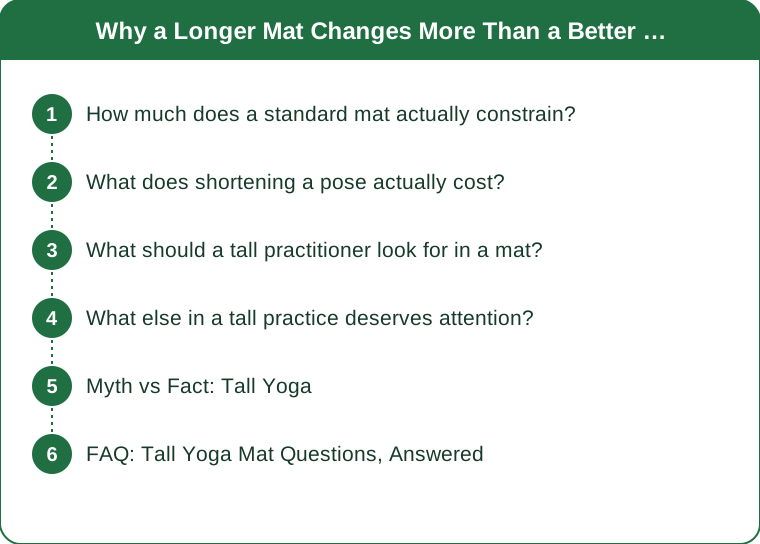
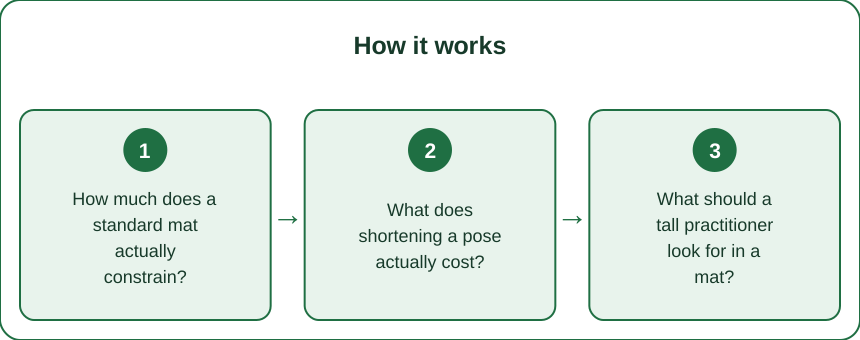
How much does a standard mat actually constrain?
Standard mats are commonly around 173cm, which is shorter than a large proportion of adult women and shorter than most adult men.
In downward dog you need mat length beyond your height, since hands and feet are further apart than your standing height in a well-proportioned dog.
In a long lunge the back foot goes off the end, which changes the grip and therefore the stability of the pose.
In reclined poses your head or feet are on the floor, which is uncomfortable and quietly shortens savasana.
In plank and chaturanga the toes are typically off the end, which changes the friction and therefore the alignment.
And the response is always the same: shorten the pose to stay on the mat, without deciding to.
What does shortening a pose actually cost?
Downward dog with hands too close reduces the length through the spine, which is the point of the pose, and shifts load to the shoulders.
A shortened lunge reduces hip flexor length, which is usually what a tall practitioner most needs from it.
A shorter stance in warrior poses reduces the leg work and changes the alignment of the front knee.
Every shortened pose is practised repeatedly, so the shortened version becomes the learned version.
Teachers frequently cue length without identifying the mat as the constraint, which leaves the practitioner trying to lengthen within a boundary they have not consciously noticed.
And the practitioner concludes they are inflexible, when the constraint was the equipment.
What should a tall practitioner look for in a mat?
Length of 200cm or more, which is widely available and is the single specification that matters most.
Width above the standard 61cm if possible, since a longer body often needs more width in wide-legged poses and side stretches.
Weight, honestly assessed. A longer, wider, thicker mat is heavy, and a mat too heavy to carry to class becomes a home-only mat.
Thickness appropriate to your practice - thinner for balance-heavy styles, thicker for restorative and floor work.
Grip that suits how much you sweat, which matters more on a larger surface where hand placement varies more.
And consider two mats, a light travel one for class and a long one at home, which is a common and practical solution.
What else in a tall practice deserves attention?
Blocks are more useful, not less. Longer limbs mean the floor is further away, and blocks bring it closer in exactly the poses that are hardest at height.
A strap changes more for a tall practitioner than for anyone else, because the distance to reach is genuinely greater.
Wall space matters, and choosing a spot with wall access is worth more than choosing one with a good view of the teacher.
Position yourself where you will not clash with neighbours in wide poses, which is a practical class consideration at height.
Longer holds may suit you better than fast flows, since transitions with long limbs take more time and rushing them is where alignment goes.
And tell the teacher you are working with a longer body, which most teachers welcome and will cue for.
Myth vs Fact: Tall Yoga
Myth: tall people are inherently less flexible.
Fact: range of motion is not determined by limb length. What differs is leverage - longer levers make some poses feel harder and require different entry - which is a mechanical difference, not a flexibility deficit.
Myth: if you are off the mat, your pose is too long.
Fact: the mat is 173cm because that is a manufacturing convention, not because it is the correct length for a pose. Being off the end usually means the mat is short, not that the pose is wrong.
Myth: blocks are for beginners.
Fact: blocks compensate for distance to the floor, which increases with limb length. Tall practitioners often benefit from them more than shorter ones, at every level.
Myth: a thicker mat is always more comfortable.
Fact: thicker mats reduce stability in balance poses, which are already harder with a higher centre of mass. Length matters more than thickness for most tall practitioners.
Myth: you should be able to do the pose as demonstrated.
Fact: demonstrations are performed by a body with specific proportions. Longer limbs change the geometry of many poses, and a well-adapted version is the correct version for you.
FAQ: Tall Yoga Mat Questions, Answered
How long should my yoga mat be?
As a rough guide, at least your height plus around 20cm. For most people over 175cm that means a 200cm mat or longer, which is widely available.
Is a wider mat worth it too?
Often yes, particularly for wide-legged poses and side stretches where a longer body extends further laterally. It also adds weight, so consider where you will use it.
Will a longer mat fit in a class?
Usually, though it is worth arriving early to position yourself. In very busy classes a standard-width long mat is easier to accommodate than an extra-wide one.
Are blocks really more useful when tall?
Yes. The floor is further away with longer limbs, and blocks reduce that distance in exactly the poses where it is limiting.
Should I get a thicker mat?
Only if your practice is floor-heavy. Thicker mats reduce stability in balance poses, which are already harder with a higher centre of mass.
Why do I struggle with balance poses?
A higher centre of mass makes balance mechanically harder, which is a physics difference rather than a skill deficit. A thinner, firmer mat and a fixed gaze point both help.
Should I tell my teacher I am tall?
Yes - most teachers appreciate it and will offer proportional cues rather than generic ones. It is a useful conversation, not a special request.
TL;DR:
- Standard mats are around 173cm, so most tall practitioners are unconsciously shortening poses to stay on them.
- Shortened dogs and lunges become the learned version, and the practitioner blames flexibility.
- Look for 200cm or more, and consider extra width - length is the specification that matters most.
- Blocks and straps are more useful when tall, not less, because the floor is genuinely further away.
- Balance difficulty is a higher centre of mass, not a skill deficit - thinner and firmer helps.
The pose was never the problem. The mat was.
See It in Motion
Seen here: High Waist Wide Leg Yoga Pants with Pockets — shop it on bubblelime.com
Keep Reading
This article is for general informational and styling purposes only. Fit, sizing, and product availability may vary.
