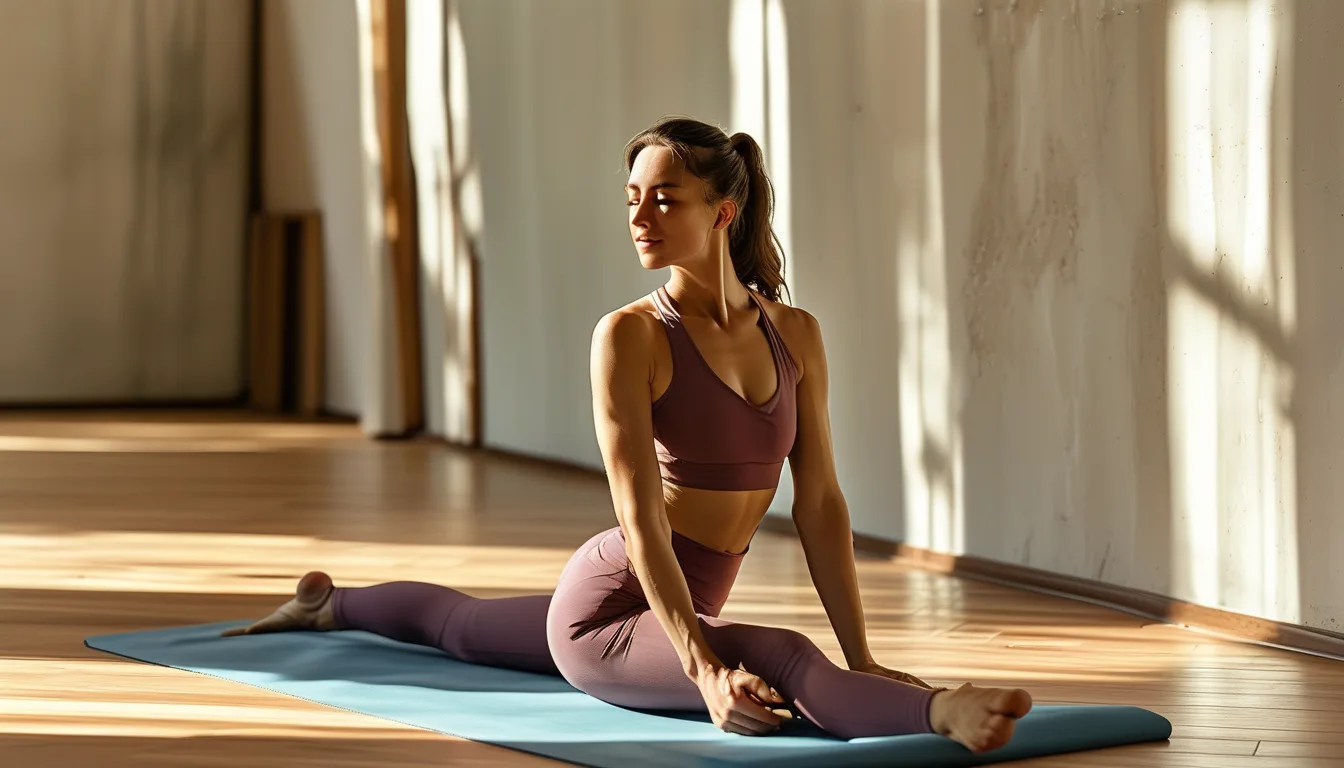
Why Restorative Poses Feel Wrong When You Are Tall
Quick Answer: Restorative poses only work when the body is fully supported, and standard bolsters are sized around an average torso and limb length. On a longer frame the same bolster leaves a gap under the head, the lower back or the knees, which means muscles stay engaged and the nervous system never fully downshifts. The fix is stacking rather than substituting — add blankets to raise height, add a second bolster for length, and prioritise supporting the head above everything else.
If a restorative pose feels like effort, the props are wrong, not you.
This blog has covered block height and reach, mat length and pose overhang, and strap length for binds. Props for restorative work are the same problem in the quietest part of the practice.

Why does a gap in support stop the pose working?
Because the entire mechanism of restorative yoga depends on the body not having to hold itself up.
Any unsupported segment stays muscularly active. If your head hangs two centimetres above a bolster, the neck muscles hold it there for the entire ten minutes.
Low-level muscular engagement blocks the parasympathetic shift that restorative practice is trying to produce. The pose looks the same and does something quite different.
Longer limbs create more places for a gap to appear. A longer torso overshoots a bolster; longer legs mean the knees are unsupported when the feet are.
Standard bolsters are around 60 to 65 centimetres long and 15 centimetres high, which is generous for an average torso and short for a long one.
A gap under the lower back is the most common and the most consequential. It keeps the lumbar erectors working and it is the reason supported backbends often produce ache rather than release.
And the discomfort arrives late. Two minutes in, everything feels acceptable. At eight minutes the unsupported segment is the only thing you can think about.
Where the gaps actually appear
Six places, and knowing which to check makes setup fast.
Under the head in supported reclining poses. If the chin is higher than the forehead, the neck is extended and working. Add a folded blanket under the head, always.
At the lower back in supported backbends. A longer torso means the bolster supports the mid-back and leaves the lumbar spine hanging. A rolled blanket in the lumbar curve fixes it.
Under the knees in savasana. Longer legs need more height under the knees to release the hip flexors and lower back, often two blankets rather than one bolster.
Under the forearms in supported child’s pose. Long arms reach past the bolster and the shoulders stay engaged. Blocks under the elbows solve it.
At the outer thighs in supported reclined bound angle. Standard blocks are frequently too short to reach a longer leg, so blankets rolled under each thigh work better.
And under the feet in seated forward folds. A longer leg means the feet reach past the props entirely, which puts all the load into the hamstrings rather than into supported release.
The test in all six cases is the same: can you let go completely and stay where you are? If letting go means dropping even slightly, the support is not there yet.

What Nobody Tells You About Restorative Props
Height matters more than length. A gap of two centimetres under the head does more damage to a pose than a bolster that is five centimetres short at the hips.
Blankets are more useful than bolsters. They stack in fine increments, they fold to any width, and every studio has plenty of them while spare bolsters are rare.
Two bolsters end to end is a legitimate setup. It is not greedy or excessive; it is what a longer torso requires, and any decent teacher will say so.
Arrive five minutes early to a restorative class. Prop setup for a longer frame genuinely takes longer, and building it under time pressure is how people end up in a pose that does not work.
A firm bolster supports better than a soft one. Soft bolsters compress under a longer, heavier torso and the gap reappears halfway through the hold.
And the home version is easy. Sofa cushions, folded duvets and firm pillows work well. Restorative props are about height and firmness, not about buying anything specific.
Tell the teacher. Most will happily fetch extra props, and most have never thought about the problem because they have never had it.
A setup that works for four common poses
Supported savasana. Bolster or two rolled blankets under the knees, folded blanket under the head so the forehead is very slightly higher than the chin, a blanket over the body. Check the lower back is in contact with the floor; if it is not, raise the knees further.
Supported reclining backbend. Bolster lengthways under the spine, a second bolster or blanket stack under the head so the neck is not extended, rolled blanket in the lumbar curve, blocks or blankets under each outer thigh.
Supported child’s pose. Bolster lengthways between the thighs, blanket stack under the head so the neck is neutral rather than turned sharply, blocks under the forearms if the arms reach past the bolster.
Legs up the wall. Folded blanket under the hips rather than a bolster, which is often too high for a longer torso and creates a lumbar gap. Slide back until the lower back is flat, then add a blanket under the head.
In every case, build from the head down. Head, then spine, then limbs. The head is the segment where a gap costs the most and the one most people set up last.
And give yourself permission to adjust mid-pose. Restorative practice is not a test of stillness. A ten-second correction at minute three buys you seven good minutes.
FAQ: Restorative Yoga Prop Questions, Answered
Why do restorative poses feel uncomfortable when I am tall?
Because standard props are sized for an average torso and limb length, which leaves gaps under the head, lower back or knees on a longer frame. Any unsupported segment stays muscularly engaged, which prevents the release the pose is designed to produce.
How many props should I be using?
As many as it takes for nothing to be holding itself up. Two bolsters plus three or four blankets is entirely reasonable on a longer frame, and it is worth arriving early to a class to build it properly.
What is the most important prop to get right?
Head support. If the chin sits higher than the forehead, the neck is extended and working for the whole hold, and that single gap will keep the nervous system from settling regardless of how good the rest of the setup is.
TL;DR:
- Restorative poses work only when nothing is holding itself up. Any gap keeps muscles engaged and blocks the release.
- Longer limbs and a longer torso create more places for gaps: head, lumbar spine, knees, forearms, feet.
- Blankets beat bolsters because they stack in fine increments. Two bolsters end to end is a normal setup.
- Build from the head down, and get head support right before anything else.
If a restorative pose feels like work, add props. The pose is not asking anything of you that support cannot solve.
Keep Reading
This article is for general informational and styling purposes only. Fit, sizing, and product availability may vary.