Why Forward Folds Feel Different When Your Legs Are Long
Quick Answer: A longer torso and longer legs mean more distance to travel and longer levers to control, so a forward fold demands more from your hamstrings and more spinal control than the same pose does on a shorter frame. The fix is not more flexibility — it is bending the knees generously, using blocks at a genuinely useful height, and judging the pose by pelvic tilt rather than by how close your hands are to the floor.
The cue says fold from the hips. You fold from the hips and, somewhere partway down, your pelvis stops rotating and your spine takes over. You feel it in your lower back, not your hamstrings.
That handover point arrives sooner on a long frame, and it is a geometry problem rather than a flexibility one. The third section explains why chasing the floor is the wrong target, and what to aim at instead.
What is different about a forward fold on a long frame?
Several things, and they compound.
More distance to travel. A fold is a rotation of the pelvis over the femurs, and the further your head is from your hips, the more arc your upper body sweeps through. The pose is longer for you in a literal sense.
Longer levers mean more load. Your torso is a weight on the end of a lever, pivoting at your hips. A longer torso means a longer lever arm, which means your hamstrings and lower back are resisting more torque at the same angle. The pose is not just longer, it is heavier.
The hamstrings are longer, and length is not the same as flexibility. A longer muscle needs to lengthen more in absolute terms to achieve the same joint angle. So even with identical relative flexibility, you have further to go.
The floor is further away. Fingertips-to-floor is a distance measurement, and it depends heavily on the ratio of your arm length to your leg length. Someone with proportionally long arms touches the floor easily at a hip angle where you would not. This makes the most common self-assessment in yoga essentially meaningless for you.
Balance is harder. A higher center of mass in a standing fold means more to control, particularly in the transition in and out.
The net effect: a fold that is well within a shorter practitioner’s range is at the edge of yours, and the instruction to relax and let gravity do it is much less good advice for you than for them.
What should you actually do in the pose?
Change the setup and the pose becomes available.
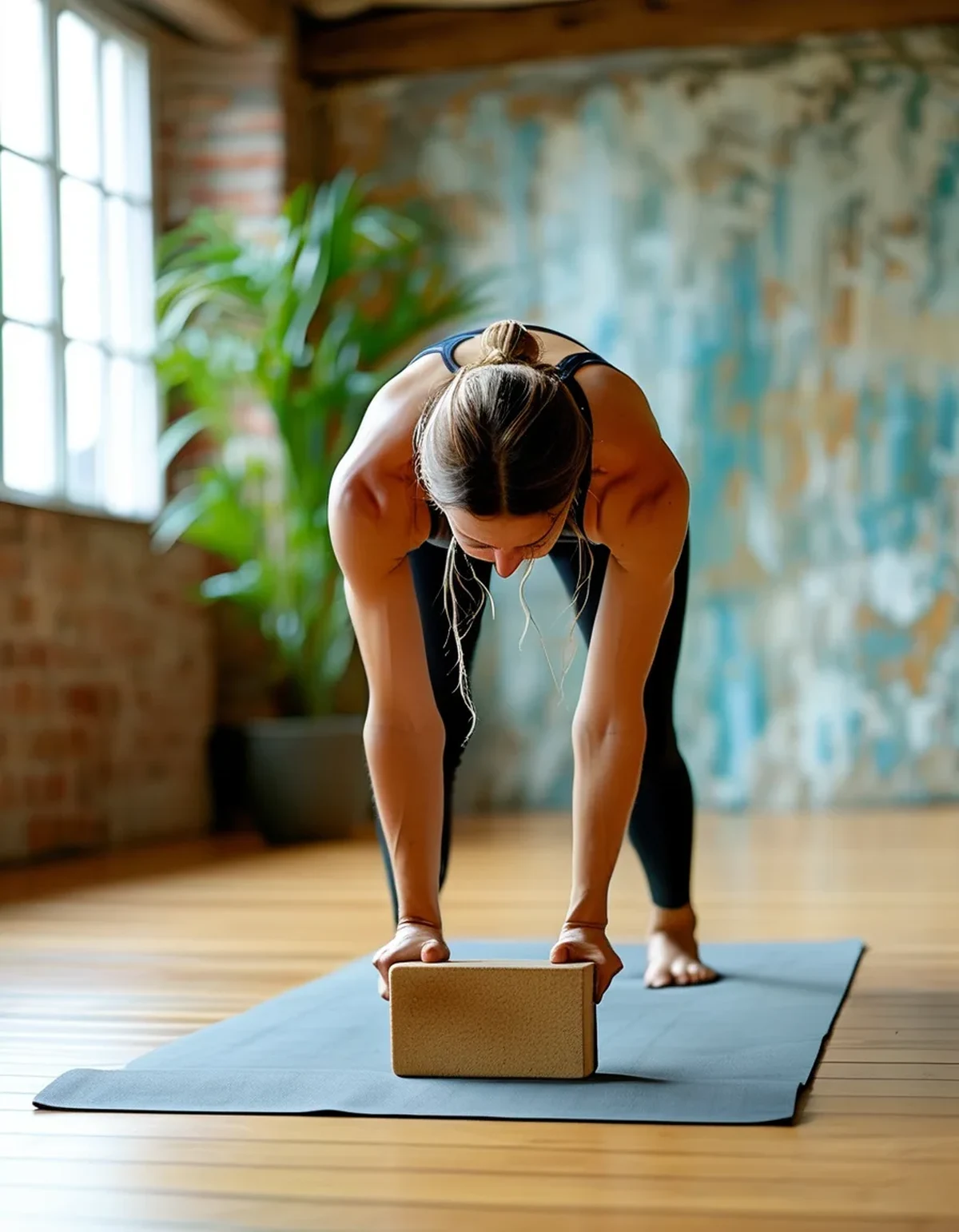
Bend your knees, generously and without apology. This is the single most useful adjustment. Bending the knees slackens the hamstrings at their lower attachment, which lets your pelvis continue rotating forward. The goal is a long spine with bent knees, not straight legs with a rounded back. On a long frame, you may need considerably more bend than the person next to you, and that is correct rather than a compromise.
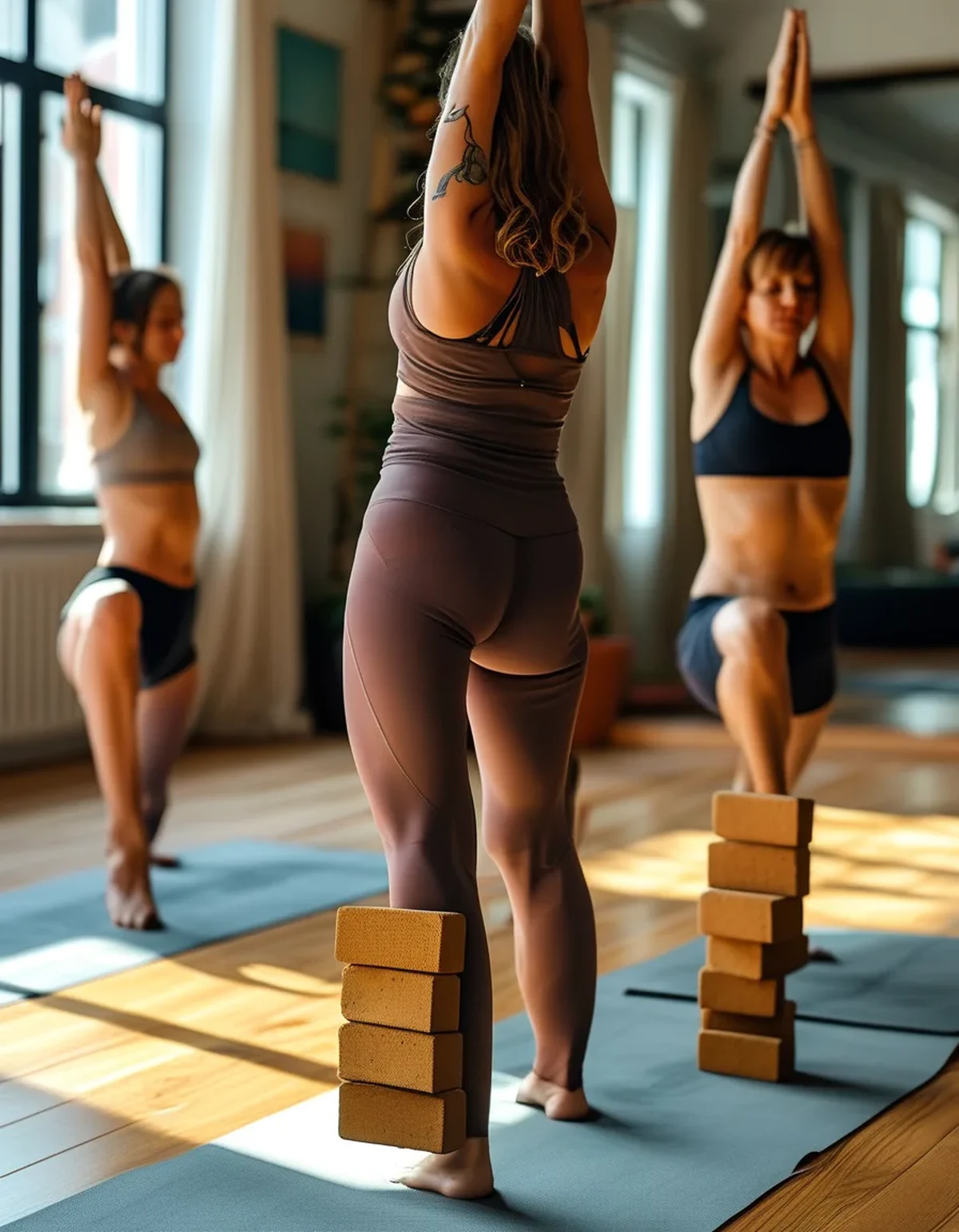
Use blocks, at a useful height. Blocks at their lowest setting are often not high enough to change anything for a tall practitioner. Use them at the tallest setting, use two stacked, or use a chair seat. The purpose is to bring the floor up to where your hands actually reach with a neutral spine.
Judge by pelvic tilt, not by hand position. Put your hands on the tops of your hips and feel the front points of your pelvis. As you fold, they should rotate forward and down. The moment they stop rotating is the end of your fold — anything past that is spinal flexion, and it does not deepen the hip hinge at all.
Widen your stance slightly. A stance closer to hip-width or a little wider gives your torso somewhere to go and reduces the compression at the hips. Turning the toes slightly in or out can also change what the hamstrings feel.
Come up with bent knees and a long spine, or by rolling up with control. Standing up from a deep fold with straight legs and a long torso is a heavily loaded lumbar movement and it is where people get into trouble.
Myth vs Fact: touching the floor is not the goal
Myth: A deeper fold, with your hands flat on the floor, means better hamstring flexibility and a better pose.
Fact: Hand-to-floor distance measures your limb proportions at least as much as your flexibility, and chasing it teaches you to round your spine.
Consider two people with identical hip mobility. One has proportionally long arms and short legs, and touches the floor comfortably. The other has long legs and a long torso and does not come close. Nothing about their hamstrings differs. Their skeletons differ.
Now consider what happens when the second person tries to reach the floor anyway. The hips have stopped rotating, so the only available movement is spinal flexion. They round the lumbar spine, load it under the weight of a long torso, and often feel it the next day.
Chasing the floor on a long frame trains exactly the pattern you are trying to avoid.
The better target is the one you can actually feel: the hinge itself. How far can your pelvis rotate over your femurs while your spine stays long? That is the pose. Whether your hands land on the floor, on blocks, on a chair, or on your shins is a consequence of your proportions and the height of the props available.
There is a related point about cueing. Most yoga cues were developed and are demonstrated on average-proportioned bodies, and they describe what the pose looks like rather than what it is doing. Cues like reach your chest toward your thighs, or fold all the way down, describe an appearance. On a long frame, following the appearance means abandoning the mechanism.
A good teacher will adapt this readily if you mention it. Most are glad to — the difficulty is that a tall student rounding their back looks like a flexibility issue from the front of the room, so it often goes uncorrected unless you say something.
If you have persistent back pain in folds, or any pain that radiates down the leg, stop and get it assessed. This is general information, not medical advice.
How should you approach hamstring work generally?
Since the fold is not the only place this shows up.
Train the hinge with a long spine, loaded. Romanian deadlifts, good mornings, and hip hinge drills with a dowel along your spine build the exact pattern the fold asks for, with feedback about when your spine gives up. This transfers to yoga better than more stretching does.
Use active flexibility work, not just passive holds. Hamstring stretching that involves contracting into the range — a supine leg raise with a strap, actively lifting rather than pulling — builds usable range. Passive hangs build tolerance to a position you cannot control, which on a long lever is not what you want.
Work the hamstring at length, with load. Nordic curls, sliding leg curls, and single-leg Romanian deadlifts build strength through the lengthened position, which improves both flexibility and resilience.
Address the hips too. Restricted hip flexion is often mistaken for tight hamstrings. If your fold stops early and you feel a pinch at the front of the hip rather than a stretch at the back of the leg, that is a different problem with a different solution.
In practice, place your props before class starts. Two blocks, set tall, next to your mat. Not reaching for them mid-sequence when you have already compromised the pose.
Expect progress to be slow and non-linear. Long tissue changes slowly and the lever will always be long. The goal is not to fold like a shorter person — it is to own the full range your own skeleton allows, safely, which is a genuinely different and more useful objective.
FAQ: Tall Yoga Fold Questions, Answered
Will I ever touch the floor with straight legs?
Possibly, depending on your proportions and hip mobility — and it does not matter much either way. Some skeletons make it easy and some make it nearly impossible regardless of hamstring length. It is not a meaningful benchmark for you.
Are blocks a beginner prop?
No. Props change the geometry of a pose to match the body doing it. On a long frame, a tall block is often what makes the pose correct rather than what makes it easier — plenty of experienced practitioners use them permanently for exactly this reason.
Why do I feel forward folds in my lower back instead of my hamstrings?
Almost always because your pelvis has stopped rotating and your spine has taken over. Bend the knees more and raise your hands onto a higher prop, and the sensation should move to the back of your legs where it belongs.
TL;DR:
- A long torso and legs mean more distance to travel and more torque at the same joint angle.
- Hand-to-floor distance measures your proportions, not your flexibility — stop using it as a benchmark.
- Bend the knees generously and use blocks at their tallest setting, or a chair.
- Judge the fold by whether your pelvis is still rotating, not by how low you are.
- Build the pattern with loaded hinge work and strength through the lengthened range.
The reframe that makes the biggest difference is realizing you are not behind — you are doing a mechanically different version of the pose, and it happens to look less impressive from the outside. Set two tall blocks beside your mat before class, bend your knees more than feels acceptable, and pay attention only to whether your pelvis is still moving. The pose gets better immediately, and your lower back stops being the part of you that remembers class the next morning.
Keep Reading
This article is for general informational and styling purposes only. Fit, sizing, and product availability may vary.
