Why Tall Yogis Should Widen Their Stance Before Deepening It
Quick Answer: Standing poses are taught with a stance length that assumes an average leg. A longer femur and tibia mean the same proportional stance requires more distance, so a tall person in a standard-width stance is effectively in a much narrower pose than the teacher intends — which is why the front knee crowds forward and the back heel lifts. Widen first, then deepen. Depth added to a too-narrow stance is where tall knees get compressed.
The cue is always sink lower. On a long leg it should almost always be step wider first.
Why does the standard stance not scale?
Because stance is usually cued in absolute terms while leg length varies substantially.
Common cues are absolute: step back three or four feet, step to the length of one leg, take a wide stance about a leg’s length apart. Some scale with your body and many do not, and the ones that do not are the problem.
A tall person’s leg is proportionally longer, so a stance cued at a fixed distance places your feet closer together relative to your own leg length. The pose then behaves like a narrow version of itself — the same angles are simply not available.
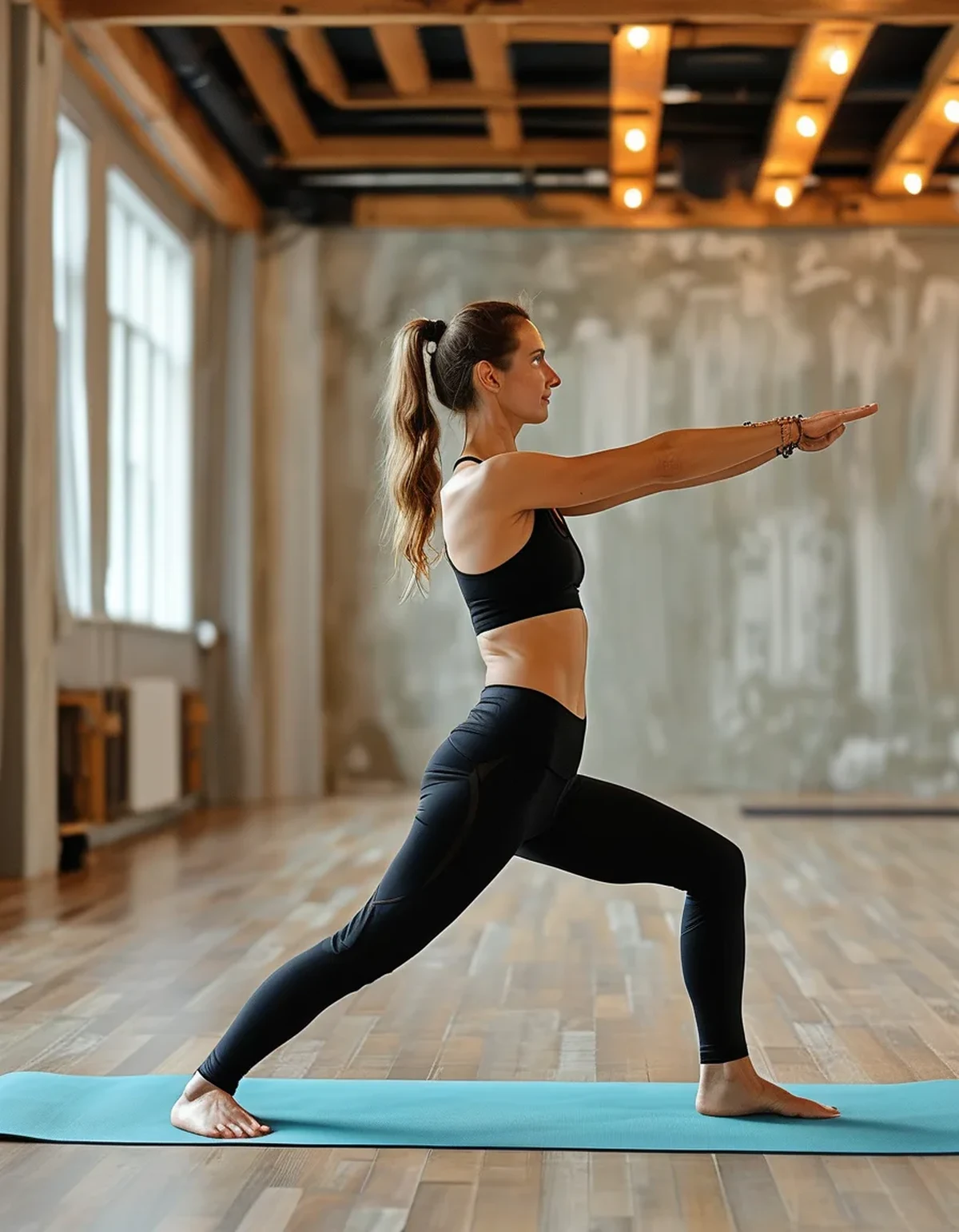
In Warrior II, that shows up immediately. The instruction is to bring the front thigh toward parallel with the floor with the knee over the ankle. In a stance that is too short for your leg, the only way to get the thigh down is to push the knee forward past the ankle, which loads the knee joint rather than the hip and thigh. You feel it in the front of the knee, and no amount of trying harder fixes it because the geometry does not allow it.
In Warrior I and low lunges, a too-short stance means the back heel cannot reach the ground and the hip flexor gets no length, so the pose becomes a balance challenge rather than the hip opener it was meant to be.
In Triangle, a too-short stance means the reach is impossible without collapsing the side body or bending the front knee, which is why so many tall practitioners end up with their hand on a shin and their ribs folded.
The general pattern: a stance that is too short for your leg converts hip work into knee work and joint compression. That is why the fix is length, not effort.
How much wider is wider?
Measure it once from your own body, and use that instead of the room’s default.
For a wide-legged standing pose like Warrior II or Triangle, a useful reference is your own leg length plus a little — heel to heel roughly matching the distance from your hip crease to the floor, then a few inches beyond. For most tall practitioners that is noticeably wider than the mat’s standard hip-to-hip default and often wider than the mat is long.
A practical way to find it:
- Stand in Warrior II at your usual stance.
- Bend the front knee toward a right angle and look down.
- If the knee travels past the ankle, step the back foot further back. Repeat until the knee stacks over the ankle with the thigh where you want it.
- Note where your feet are relative to the mat — a mat edge, a seam, a line on the floor. That is your stance, and it is a repeatable reference.
For lunges and Warrior I: step back until the front knee is over the ankle at your working depth and the back heel can reach the floor or a lifted position without straining. Tall practitioners usually need a longer step than they have been taking, and the back heel is the honest test.
A useful marker: your stance may not fit the mat. A standard mat is 68 to 72 inches long, and a tall person’s proper wide stance can exceed the width of the mat when turned sideways. Stepping a foot onto the floor beyond the mat is correct, not a mistake — and in a crowded class, positioning yourself with space on one side is a legitimate need to plan for.
And the depth question, once the width is right: depth is then optional and safe. A well-lengthened stance lets you take the thigh toward parallel with the knee tracking properly, which is the pose as designed.
Which poses change most, and how?
Five, with the specific adjustment for each.
Warrior II. Widen until the front knee stacks over the ankle with the thigh at your working depth. Check by looking straight down — you should see your ankle, not just your toes. Back foot turned in slightly, back leg straight and active.
Triangle. Widen substantially. A longer torso and longer arms mean the reach travels further, so a stance that lets you keep the front leg straight and the side body long is much wider than the standard cue. Use a block under the bottom hand rather than reaching for the shin — a block is not a regression for a tall person, it is a length correction.
Warrior I and low lunge. Step longer, not deeper. The test is the back heel and the front knee together — heel reaching, knee over ankle. If you cannot have both, the stance is short.
Downward dog. This is the pose tall practitioners most often set up too short, because the mat suggests a length. Long arms and long legs need more distance between hands and feet than the mat implies. Walk the feet back until the spine is long and the hips are the highest point; if your heels are nowhere near the floor and your back is rounding, the stance is too short, not your hamstrings too tight.
Wide-legged forward fold. Wider than cued, and expect to need blocks under the hands — a longer torso and arms means the floor is genuinely further away in a way that has nothing to do with flexibility.
Across all of them, the same principle: length first, then depth, then any refinement. And props are length tools, not difficulty reductions — blocks, a strap, and a folded blanket exist to bring the floor closer to a longer body.
Myth vs Fact: Tall Bodies in Standing Poses
Myth: Going deeper is always the progression. Fact: In a stance that is too short for your leg, depth is added at the knee rather than the hip, which is loading the joint instead of the muscles. Length is the progression that makes depth safe. A wider, shallower Warrior II is a better pose than a narrow, deep one.
Myth: If your heels do not reach the floor in downward dog, your hamstrings or calves are tight. Fact: Sometimes, and for tall practitioners the stance length is at least as likely a cause. Long limbs need a longer distance between hands and feet, and a dog set to mat-suggested proportions puts a tall body in an angle where the heels cannot descend regardless of flexibility.
Myth: Using blocks means you are less advanced. Fact: A block compensates for the fact that a longer torso and longer arms put the floor further away. Two people with identical flexibility and different proportions need different props to reach the same alignment. The prop is serving the alignment, which is the actual goal.
Myth: Your stance should fit on the mat. Fact: The mat is a standard size and your legs are not. A proper wide stance for a tall practitioner routinely exceeds the mat’s width, and a foot on the floor is fine. Letting the mat dictate your stance is letting a piece of equipment set your alignment.
Myth: Teachers’ cues should work for everyone in the room. Fact: General cues are written for a general body and they are a starting point. A good teacher will adapt them if asked; the practical move is to tell a teacher you are working on stance length for your proportions, which usually produces genuinely useful individual guidance rather than a repeated general instruction.
How do you work this into practice?
Set your references once, then use them every time, and expect the poses to feel different.
Establish your markers in a quiet practice, not a busy class.
- Find your Warrior II stance using the knee-over-ankle test, and note where your feet sit relative to the mat.
- Find your lunge length using the back-heel-and-front-knee test.
- Find your downward dog distance by walking the feet back until the spine lengthens.
- Write them down — mat edge, one hand past the mat, whatever the reference is. You will forget in a busy class otherwise.
Then place yourself in class accordingly. Set up with space on the side you will step toward, and arrive early enough to choose. This is a practical need, not a preference — a tall practitioner in a packed row genuinely cannot take the stance the pose requires.
Expect it to feel like less at first. A wider, properly aligned Warrior II is often less intense in the quad and more demanding in the glute and adductor, which reads as easier when it is actually more correct. The sensation moving from the front of the knee to the hip and inner thigh is the signal that you got it right.
Keep the props on the mat by default. Two blocks and a strap, every practice. Not fetched when a pose fails — placed at the start, because you will need them for the same three poses every time.
And build the strength that a long lever demands. Longer limbs mean longer lever arms, so holding a wide stance is genuinely harder work. Glute and adductor strength — lateral lunges, Copenhagen holds, single-leg work — makes wide stances sustainable rather than something you can only hold for three breaths.
Seasonal note: classes fill up from September as outdoor practice ends, so mat space gets tighter exactly when you need more of it. Worth arriving earlier over the coming months, or holding one home practice a week where space is not the limiting factor. If a pose produces knee pain rather than muscular effort, come out of it and check the stance before pushing on — and get persistent joint pain assessed rather than adjusting around it. This is general information, not medical advice.
FAQ: Tall Practitioners and Stance, Answered
How wide should my Warrior II stance be?
Wide enough that when the front thigh reaches your working depth, the knee stacks over the ankle rather than travelling past it. Look straight down and check whether you can see your ankle. For most tall practitioners that stance is wider than the standard cue and sometimes wider than the mat, and both of those are fine.
Should I keep using blocks, or work toward not needing them?
Keep using them where proportion, rather than flexibility, is what puts the floor out of reach. A longer torso and longer arms mean the distance to the ground is genuinely greater at the same hip mobility, and a block simply restores the alignment the pose was designed around. Where blocks are compensating for actual tightness, they are also the right tool while that changes.
Why do my knees hurt in lunges even when I go carefully?
Most often because the stance is too short for your femur, so the depth you take is absorbed at the knee joint rather than distributed through the hip. Step the back foot further back until the front knee sits over the ankle and the back heel can reach, then reassess. If pain persists after correcting the stance, get it looked at properly rather than continuing to modify around it.
TL;DR:
- Standing poses are cued at absolute distances, so a longer leg ends up in a proportionally narrow stance
- A too-short stance forces the front knee past the ankle, which converts hip work into knee compression
- Widen or lengthen first, then add depth — depth in a short stance is where tall knees get loaded
- Warrior II, Triangle, lunges, downward dog, and wide-legged folds all need more distance than the standard cue
- Set your own markers once, keep two blocks on the mat, choose a spot with side space, and build glute and adductor strength
Every cue in the room says go lower. On a long femur the first word should be wider, and once the stance is right the depth arrives on its own without your knee paying for it.
See It in Motion
Seen here: High Waist Wide Leg Yoga Pants with Pockets — shop it on bubblelime.com
Keep Reading
This article is for general informational and styling purposes only. Fit, sizing, and product availability may vary.
