Why Balance Poses Are Harder When You're Tall and the Drills That Fix Them
Quick Answer: A standing balance is an inverted pendulum: the taller the pendulum, the higher the centre of mass, the larger the sway at the top, and the more corrective torque every wobble demands from one ankle. Long levers also mean your corrections travel further before they land. None of that is a balance deficit — it is a body-geometry surcharge, and it responds directly to training: ankle-strategy drills, a disciplined gaze, deliberate scaling, and props sized for your actual proportions.
Here is what the physics changes, which poses expose it, and the five-minute drill block that pays it off.
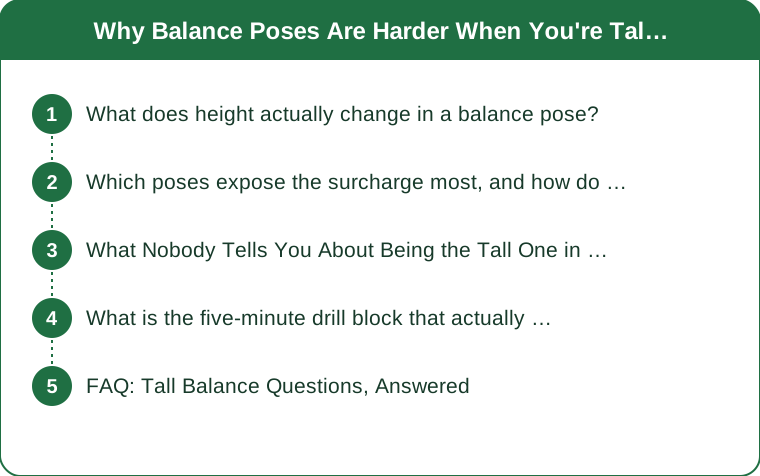
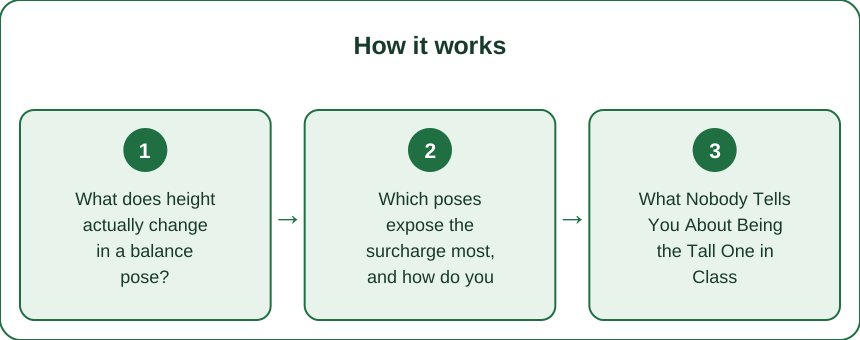
What does height actually change in a balance pose?
Three mechanical facts, none of them about skill.
Your centre of mass rides higher. Balance is the job of keeping the body’s mass centred over the base of support — one foot, in tree or dancer. A taller body carries that mass point further from the floor, and the same small angular lean translates into a bigger absolute drift at the top of a taller structure. The wobble your shorter neighbour damps with a toe press has, on your frame, already travelled twice as far by the time you catch it.
Corrections take longer to arrive. Taller pendulums swing at a slower natural frequency, and signals travel further along longer limbs. The practical feel: you are always correcting slightly later than feels fair, which reads as shakiness and is actually latency.
One ankle supplies the torque for all of it. Small sways are managed by the ankle strategy — rapid, precise corrections from the muscles crossing the ankle. More mass, higher up, swaying wider means each correction demands more force from the same small joint. Tall practitioners’ ankles fatigue sooner in holds, and a fatigued ankle hands the job to the hip strategy, which looks like the big lurching correction everyone tries to avoid in class.
There is one genuine consolation: longer feet enlarge the base of support in the direction that matters most, and long arms are outriggers — which is why your airplane and warrior three often look steadier than your tree. The physics gives with one hand what it takes with the other; training simply moves the ledger in your favour.
Which poses expose the surcharge most, and how do you scale each?
Ranked roughly by how hard the physics bites, with the scaling that keeps the pose honest.
Half moon is the ceiling. One leg, torso horizontal, mass distributed along the longest possible lever. The single biggest tall-specific fix is the prop: a standard block under a long arm is effectively a shorter block — use the tallest setting or stack, so the floor comes up to your proportions. Reaching low for an under-tall block drags the whole pose off axis before balance even begins.
Dancer and standing big-toe pose punish long levers next. The extended leg is a huge torque arm; shorten it honestly — a bent extended knee in dancer, a strap in big-toe pose — and the balance component becomes trainable instead of hopeless. The strap is not a compromise; it is resizing the pose to your limbs.
Tree is the diagnostic. High foot placement plus prayer hands is the full-price version; scale by widening the hands or lowering the foot, and treat the wall not as failure but as a latency trainer: fingertips on, find stillness, lift off for five breaths, return.
Warrior three and airplane are where tall frames win early. Arms back like a skydiver turns your span into stabilisers. Build confidence here first, then spend it on the vertical poses.
Eagle is the tall practitioner’s secret favourite — long limbs wrap easily, the pose is compact, and the double-cross lowers your centre of mass. When a sequence batters you, eagle is where you collect points back.
And everywhere: the gaze is non-negotiable. A fixed drishti at eye level or below, on something that does not move, gives your slower pendulum the one free stabiliser available. Eyes wandering to the mirror or the clock costs a tall frame more than anyone else in the room.
What Nobody Tells You About Being the Tall One in Class
The demo timeline was not set for your levers. Instructors count breaths against their own proportions; a five-breath half moon costs a taller body measurably more corrective work. Coming out one breath early with control is advanced practice, not shortfall.
Mat geography is strategy. The spot with a wall within fingertip reach and a stable visual anchor ahead — not the mirror, which doubles every wobble visually — is worth arriving three minutes early for. Experienced tall practitioners pick their spot the way climbers pick holds.
Your wins are real; collect them. Binds arrive years earlier for long arms, wraps are gifts, seated forward folds read dramatic, and floor-to-standing transitions cover distance shorter bodies cannot. A practice narrated only by its balance struggles is an inaccurate practice.
Fatigue timing explains your bad days. Balance quality tracks ankle freshness, and tall ankles work harder per hold — so the wobble in the third balance pose of a sequence is scheduling, not regression. Sequence-aware scaling (full tree early, wall tree late) is how the tall practice matures.
Standard props assume standard proportions. Blocks at their tallest, straps used without apology, and a folded mat under the standing foot removed — cushion is a balance tax — are equipment corrections, not accommodations.
And the leggings matter more mid-balance than anywhere else. A waistband you have to hitch mid-tree is a dropped drishti; tall-inseam yoga pants that stay put through the full fold-and-extend cycle keep your attention where the pose needs it. It is a small edge, and balance poses are made of small edges.
What is the five-minute drill block that actually moves the needle?
Balance is trainable at any height — the surcharge just means the training pays you more.
Minute one: ankle wake-up. Barefoot, slow calf raises with a three-second lower, then ankle circles each way. You are priming the exact muscles the ankle strategy bills.
Minutes two and three: single-leg clock. Stand on one foot, hover the other, and tap it lightly to twelve, three, six, and nine o’clock positions, twice around, then switch legs. This trains corrective torque through real ranges rather than static freezing — the difference between balancing and bracing.
Minute four: eyes-closed stand. Feet hip-width, close the eyes, thirty seconds; progress over weeks to narrow stance, then single-leg with fingertips on a wall. Removing vision forces the ankle and inner-ear systems to carry the load they under-train when eyes do everything — and taller frames, with more visual dependence, gain most.
Minute five: the toe press. In a comfortable single-leg stand, consciously press the big toe down and feel the arch engage, five breaths a side. The big toe is the ankle strategy’s front-line tool; most wobble-catching happens there, and most people have never once trained it deliberately.
Do the block before practice, three times a week, and expect the compounding to be quiet: two weeks buys steadier tree, six weeks moves half moon, and the eyes-closed numbers keep climbing for months. Balance responds to specific practice faster than almost any fitness quality — the physics set your starting price, not your ceiling.
One honest caveat: balance that deteriorates suddenly, or comes with dizziness, is a clinician’s question, not a drill’s. This is general practice guidance, not medical advice.
FAQ: Tall Balance Questions, Answered
Am I actually worse at balance because I am tall?
You are working against a mechanically harder problem — higher centre of mass, longer levers, later corrections — with the same neurological equipment. Untrained, that shows as extra wobble; trained, tall practitioners hold the same poses. The deficit is a surcharge, and surcharges can be paid off.
Why is my tree pose fine but half moon a disaster?
Tree keeps your mass stacked vertically over the foot; half moon stretches it along a horizontal lever, which multiplies the torque your standing side must manage — and an under-tall block makes it worse by pulling you off axis. Raise the block to its full height or stack two before judging your half moon.
Should I look at one spot or soften my gaze?
For balance poses, one fixed point at eye level or below, on something genuinely still. The soft gaze belongs to flowing transitions; the locked drishti is the tall frame’s free stabiliser, and dropping it costs you more than it costs shorter classmates.
Do balance boards or cushions help me progress faster?
For yoga balance specifically, firm-surface single-leg work — the clock drill, eyes-closed progressions — transfers best. Unstable-surface toys train a different, springier skill; fun, but the pose happens on a firm floor, and so should most of the training.
TL;DR:
- A taller body is a taller inverted pendulum: higher centre of mass, wider sway at the top, later corrections, and more torque demanded from one ankle — a surcharge, not a deficit.
- Scale the exposed poses honestly: blocks at full height in half moon, straps and bent knees to shorten long levers, walls as latency trainers, and eagle as the tall win.
- A locked drishti, smart mat placement, sequence-aware scaling, and gear that stays put are the quiet edges; long feet and outrigger arms are the physics paying you back.
- Five minutes, three times a week — calf raises, the single-leg clock, eyes-closed stands, the big-toe press — moves tree in two weeks and half moon in six.
Add the clock drill before your next class and give it fourteen days. The pendulum stays tall; the ankle underneath it gets serious.
See It in Motion
Seen here: High Waist Yoga Leggings with Side Pockets — shop it on bubblelime.com
Keep Reading
This article is for general informational and styling purposes only. Fit, sizing, and product availability may vary.
