Why Mat Placement Matters More When You're Tall in a Full Class
Quick Answer: Your reach in a wide-legged or arms-out pose scales with your height, so a standard mat spacing that works for an average practitioner leaves a taller one short of room in both directions. Studios space mats by mat width, not by wingspan. Choose an edge or a wall position, arrive early enough to pick, and use a longer mat. The edge of the room is not the back of the class - it is the correct spot.
You are not taking up too much space.
You are being allocated a rectangle sized for someone else.
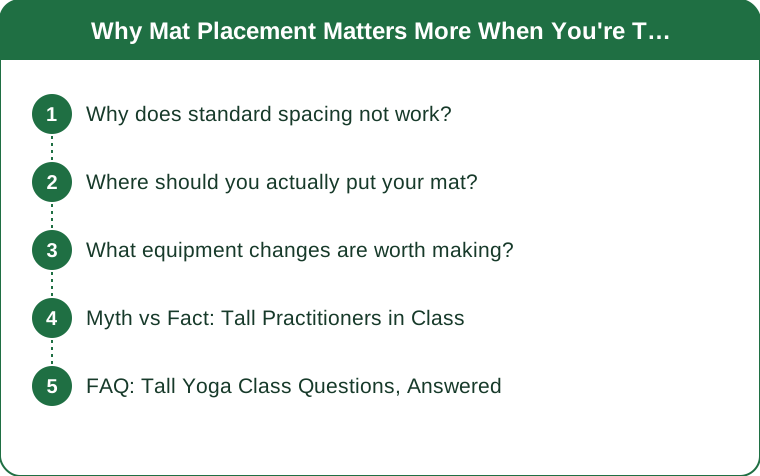
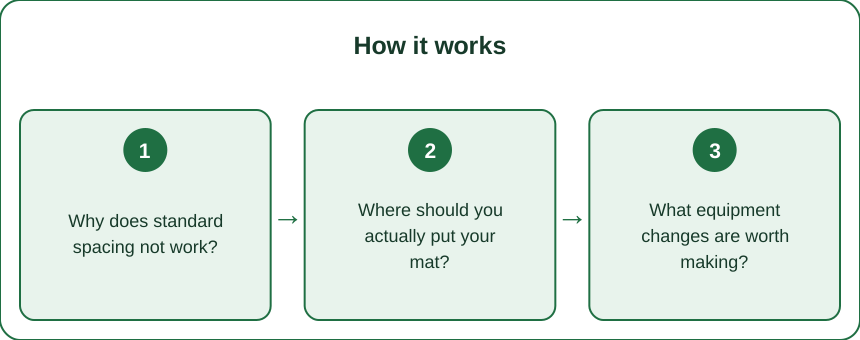
Why does standard spacing not work?
Because mats are laid out by mat dimensions, and poses are performed at arm span.
Mat width is a fixed standard, and arm span is not. Arm span roughly tracks height, so a taller practitioner reaches considerably further in a warrior or a triangle than the mat’s width allows. The mat marks your floor, not your practice space.
Standard mat length is also short for taller bodies. In a plank or a full-body pose, hands and feet end up off the mat. Hands on a hard studio floor slip differently from hands on a mat, which changes your setup and can be genuinely unsafe in a sweaty class.
Rows are set up by the first few arrivals. Whoever puts their mat down first sets the grid, and everyone else follows it. Arriving late means inheriting a spacing decision made for average bodies.
Which shows up in specific poses. Wide-legged forward folds, warrior two, and anything with arms extended sideways are where the collision happens. These are exactly the poses where a taller practitioner needs the most room.
And compromising the pose is the real cost. Shortening your stance to avoid the neighbouring mat changes the whole shape of the pose. You are practising a smaller version of it every time, which limits what you get from the class.
Inversions add a vertical version of the same problem. Ceiling clearance for a headstand or handstand is not universal, and studios in converted spaces vary a lot.
Where should you actually put your mat?
Edge positions, with a wall, and with an escape direction - in that priority.
The edge of a row is the best position. One side has nobody on it, which gives you the room you need in wide poses. This is the single most effective change and it costs nothing but arriving five minutes earlier.
Against a wall is even better. A wall gives you edge space plus a prop for balance and inversion work. For a taller practitioner, wall access is genuinely useful, not a beginner’s crutch.
Front row is often more spacious than the back. Everyone crowds the back, and the front frequently has more room and a clearer sightline to the teacher. The back row is the crowded row in most classes.
Avoid being directly behind someone in a small room. Forward folds and downward dogs put you into the space of the mat in front. Offset your mat rather than aligning it perfectly with the row ahead.
Check the ceiling if you do inversions. Look up before you commit to a spot. A beam or a low light fitting is a real constraint for anyone with a long body inverted.
And arrive early enough to choose. Five to ten minutes early is the difference between picking your position and inheriting one. This is the whole strategy - everything else follows from it.
What equipment changes are worth making?
Three, and one of them is transformative.
Buy a longer mat. Extra-long mats exist and are widely available. Hands and feet on the mat in every pose changes grip, stability, and confidence more than any other single purchase for a tall practitioner.
Get a wider mat if you can. Extra-wide mats give you room in wide-legged poses without encroaching on anyone. Width is the less-known option and it addresses exactly the collision problem.
Use two blocks, and use them higher. Longer arms mean the floor is further away, so blocks at their tallest setting are the correct starting point rather than a modification. Tall practitioners should default to blocks in forward folds and half-moon.
A longer strap. Standard straps are short for long limbs in binds and seated stretches. The extra length is inexpensive and removes a constant frustration.
Consider a towel for grip on the overhang. If your mat is standard length and you cannot replace it yet, a small towel where your hands land solves the slipping problem. A stopgap, but an effective one.
And tell the teacher. A teacher who knows you need more room will often adjust the layout or suggest a spot. Most teachers appreciate being told and nobody can see the problem from the front of the room.
Myth vs Fact: Tall Practitioners in Class
Myth: taking an edge spot is taking the easy option. Fact: the edge gives you the room to do the pose fully, which makes the practice harder, not easier. The edge is a technical choice, and teachers understand it immediately if you mention it.
Myth: if you need blocks, you are less flexible. Fact: longer limbs mean a longer distance to the floor at the same hip angle. A tall practitioner using blocks may have more range than a shorter one reaching the floor without them - the block corrects for geometry, not flexibility.
Myth: standard mats are fine for everyone. Fact: standard mat length is a manufacturing convention, not an ergonomic one. Extra-long mats exist because standard ones do not fit a large number of people.
Myth: you should shrink your poses in a crowded class. Fact: consistently practising a shortened version of a pose teaches a shortened version. Better to move your mat than to shrink your practice, every time.
Myth: the wall is for beginners. Fact: wall work is used at every level, and for inversions with a long body it is a sensible safety measure. Ceiling and wall constraints are physical facts, not skill indicators.
Myth: teachers will notice you need more space. Fact: from the front of a full room, this is close to invisible. Say something before class - it takes ten seconds and usually solves it permanently. If a pose consistently causes joint pain rather than stretch, that is worth raising with a teacher or a physio. This is general information, not medical advice.
FAQ: Tall Yoga Class Questions, Answered
How much longer should my mat be?
Long enough that your hands and feet stay on it in a plank and a downward dog. Extra-long mats are commonly available in a few lengths - measure yourself in a plank at home against your current mat and work from there.
Is it rude to move my mat once class has started?
No, and teachers generally prefer it to you practising cramped. Move between sequences rather than mid-pose, and it will pass unnoticed.
Why do the teacher’s cues never work for me?
Because many alignment cues assume average proportions - hands under shoulders and feet hip-width assume a particular ratio of limb to torso. Cues are starting points, and a longer body often needs a slightly wider or longer stance than the cue describes.
TL;DR:
- Mats are spaced by mat width, poses are performed at arm span - so standard spacing under-serves a taller practitioner.
- Take an edge or wall position and arrive five minutes early enough to choose it.
- An extra-long mat is the highest-value purchase - hands and feet stay on the mat in every pose.
- Default to blocks at their tallest setting; the floor is genuinely further away for you.
- Tell the teacher. It is invisible from the front of the room and usually fixed in ten seconds.
Arrive early to your next class and take the wall. One position change fixes half the poses you have been shrinking.
See It in Motion
Seen here: High Waist Drawstring Wide Leg Yoga Pants with Pockets — shop it on bubblelime.com
Keep Reading
This article is for general informational and styling purposes only. Fit, sizing, and product availability may vary.
