Why Standard Mat Length Changes Which Poses You Can Actually Hold
Quick Answer: A standard yoga mat is 173cm (68 inches) long and 61cm wide — sized so an average practitioner fits lying down. If you are taller, your hands or feet leave the mat in half the poses, which changes the friction under them mid-pose. That inconsistent grip, not your balance, is what produces the wobble. A 183-200cm mat fixes it, and it changes the practice more than most people expect.
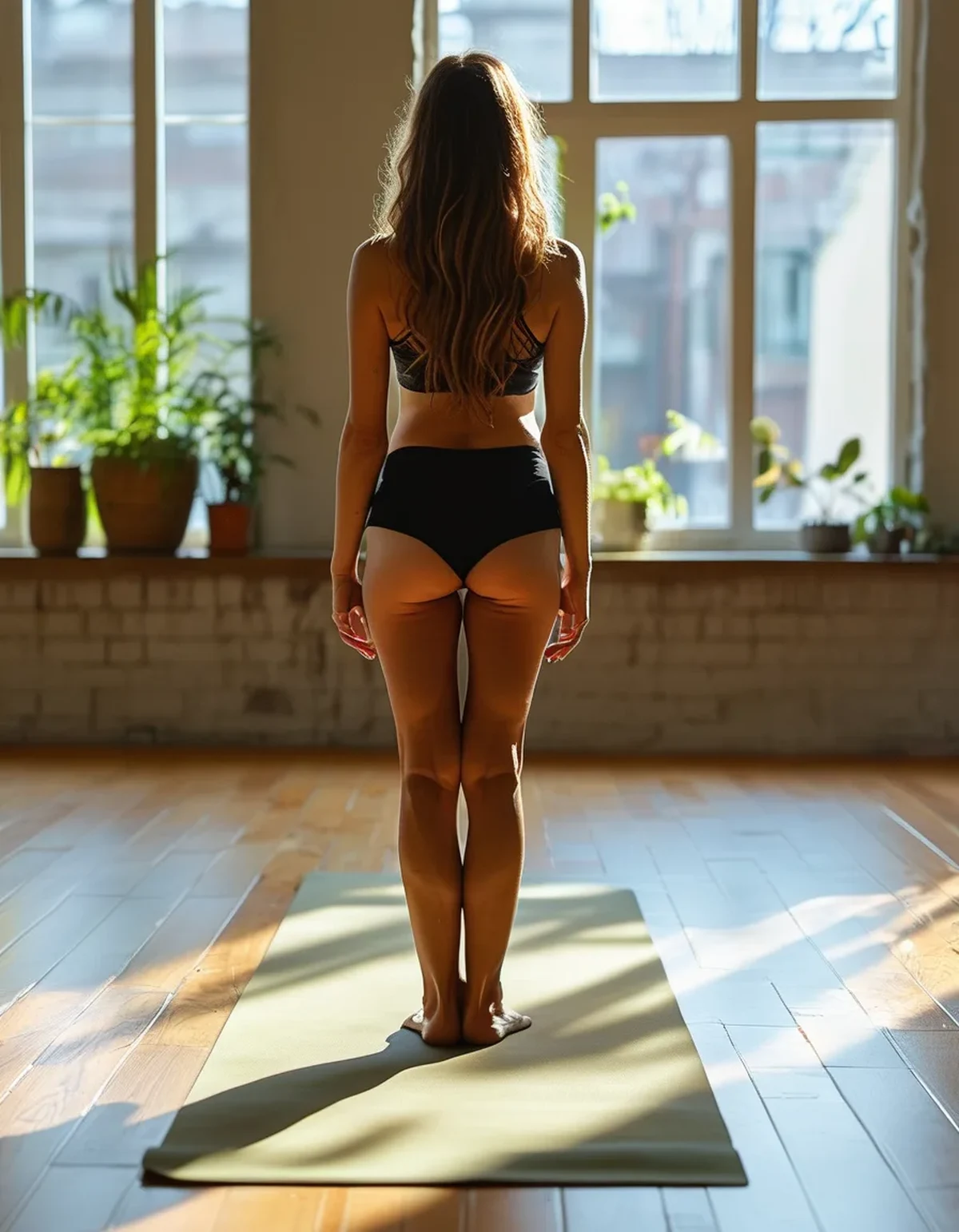
One foot on rubber.
One foot on studio floor.
Two different friction coefficients in a pose that requires you not to slide.
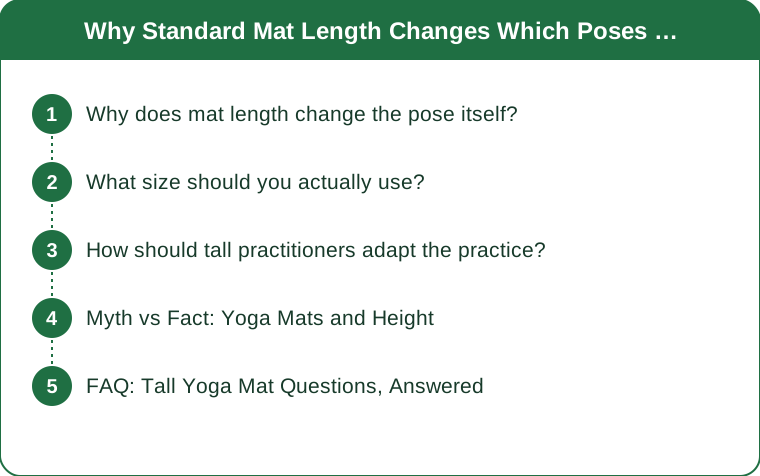
Why does mat length change the pose itself?
Six ways a short mat quietly alters what you are doing.
Split friction is the core problem. Mat rubber and studio flooring have very different grip. With one foot on each, any pose that relies on isometric tension between the feet — warrior two, triangle, wide-legged forward fold — becomes unstable in a way that feels like a balance failure.
Standing poses need more mat width than length for tall practitioners. A wide stance in warrior two commonly exceeds 120-140cm foot to foot for a taller person, and a 61cm-wide mat is set up to be used lengthwise. Turning to face the long edge fixes width but then your practice runs the wrong way relative to the class.
Downward dog runs off the end. Hands at one end and feet at the other is a longer span than the mat provides. Hands on a hard floor while feet grip rubber changes both the pressure distribution and your ability to press back.
Lying poses leave your head or feet off. Savasana with your head on the floor is a small thing and it is a slightly cold, slightly harder surface for the most restful part of the class.
You unconsciously shorten your stance to stay on. This is the subtle one. Practitioners adjust their stance to fit the mat rather than to fit their body, which means a tall person practises a systematically shorter version of every standing pose — and never finds the depth the pose is supposed to have.
Alignment cues assume you fit. Cues like front heel to back arch, or hands mat-width apart, are calibrated to a body that fits the mat. Applied literally to a taller frame on a standard mat, they produce a cramped shape.
What size should you actually use?
Six specifications worth knowing before you buy.
Length: aim for your height plus about 10cm. A 183cm (72 inch) mat suits most practitioners up to about 175cm, and 200cm (78-80 inch) mats exist for taller frames. Extra-long mats are widely available and no longer specialist.
Width matters as much as length. Standard is 61cm; wider mats at 66-71cm give standing poses somewhere to go and make a real difference in wide stances and in any pose where the hands go wide.
Thickness is a trade-off, not an upgrade. 4-5mm is the general-purpose standard. Thicker mats at 6mm+ are kinder to knees and noticeably less stable in balance poses. For a taller frame with a higher centre of mass, stability usually wins.
Material determines grip, and grip determines confidence. Natural rubber grips best, particularly when damp. PVC is durable and less grippy. TPE is light and moderate. For hot classes, grip is the whole decision.
Weight matters if you carry it. Longer and wider means heavier — a large natural rubber mat can exceed 3kg. If you are commuting to class, consider a lighter travel mat for transport and a large one at home.
Check studio policy on space. Some busy studios have marked spacing that a wider mat exceeds. Arriving early and taking an edge position solves this, and is worth doing anyway if you need more room for a wider stance.
How should tall practitioners adapt the practice?
Six adjustments beyond the mat itself.
Take a wider stance than the cue suggests. Standard alignment cues assume average proportions. A longer femur needs a wider base in warrior two and a longer stance in lunges. Trust the shape and the sensation over the literal cue.
Use blocks more, not less. Blocks are usually framed as a tool for less flexible practitioners. For a taller frame, they compensate for the greater distance from your hands to the floor, and they are what makes triangle and half moon feel correct rather than collapsed.
Bend the knees more in forward folds. Longer hamstrings under longer levers means more tension at the same relative flexibility. A generous knee bend in a forward fold is a proportionally sensible choice, not a compromise.
Adjust hand placement in downward dog. A longer torso and longer limbs generally needs a longer distance between hands and feet than the mat suggests. Walking the feet back further is usually right.
Practise near a wall for balance work. A higher centre of mass genuinely makes standing balances harder. A wall within reach is a tool, not a failure.
Check the clothing that is fighting you. Leggings riding down in a forward fold or a top riding up in downward dog interrupts practice repeatedly. Longer inseams and longer body lengths solve it — sizing up adds width and still ends short.
Seasonal note: autumn is when studios get busy again after summer and space gets tighter, which is exactly when a wider mat becomes awkward and an edge spot becomes valuable. Cooler studios also mean tighter hamstrings early in class, so a longer warm-up matters more for long-levered bodies than for average ones.
Myth vs Fact: Yoga Mats and Height
Myth: wobbling in standing poses means poor balance. Fact: it frequently means split friction between mat and floor. Get both feet onto the same surface and see what remains.
Myth: a standard mat suits everyone. Fact: 173cm x 61cm was sized around an average body. Longer and wider mats exist precisely because a substantial number of people do not fit.
Myth: thicker mats are better. Fact: thicker is kinder to knees and less stable in balance. 4-5mm is the general-purpose sweet spot, particularly for a higher centre of mass.
Myth: using blocks means you are less advanced. Fact: blocks bring the floor to a body whose hands are further from it. For tall practitioners they are a proportional adjustment, not a modification.
Myth: you should match the alignment cue exactly. Fact: cues are calibrated to average proportions. A longer femur needs a wider stance, and following the cue literally produces a cramped pose.
Myth: an expensive mat is mostly branding. Fact: material genuinely determines grip, and grip determines whether you can hold a pose while damp. For hot classes it is the single most functional specification there is.
FAQ: Tall Yoga Mat Questions, Answered
What size mat do I need?
Aim for your height plus about 10cm. Standard is 173cm; 183cm and 200cm options are widely available.
Does width matter?
Yes — arguably as much as length. Standard is 61cm; 66-71cm makes wide stances and wide hand placements far more workable.
Why do I wobble in warrior two?
Often because one foot is on the mat and one on the floor, with different friction under each. It reads as balance and is not.
What thickness should I choose?
4-5mm for general practice. Thicker is easier on knees but noticeably less stable, which matters more with a higher centre of mass.
What material grips best?
Natural rubber, especially when damp. It is heavier and worth it if you sweat or take hot classes.
Should I use blocks?
Yes. For a longer frame they bring the floor closer to hands that are genuinely further from it. That is proportion, not modification.
Will a bigger mat annoy the studio?
Rarely, if you arrive early and take an edge position. Some busy studios have marked spacing, so it is worth asking once.
TL;DR:
- Standard mats are 173cm x 61cm, sized for an average body — so hands or feet end up on the floor.
- Split friction between mat and floor causes the wobble that feels like a balance problem.
- Buy your height plus 10cm, and consider 66-71cm width for standing poses.
- 4-5mm thickness and natural rubber for stability and grip.
- Wider stances, more blocks and deeper knee bends are proportional adjustments, not modifications.
At your next class, check where your feet actually are in warrior two. If one is on the floor, that is your wobble explained.
Keep Reading
This article is for general informational and styling purposes only. Fit, sizing, and product availability may vary.
