Why Sun Salutations Cost Tall Yogis More Energy Than Everyone Else
Quick Answer: A tall practitioner’s hands travel further through every transition of a sun salutation, and the work of moving a limb scales with both its length and its mass. Over a ten-round sequence at the same pace, that is meaningfully more total work - which is why tall yogis fatigue earlier in vinyasa classes. The fixes are taking a wider stance, stepping rather than jumping, using a slightly slower breath count, and modifying chaturanga - none of which are compromises.
Here is the mechanics and what to change.
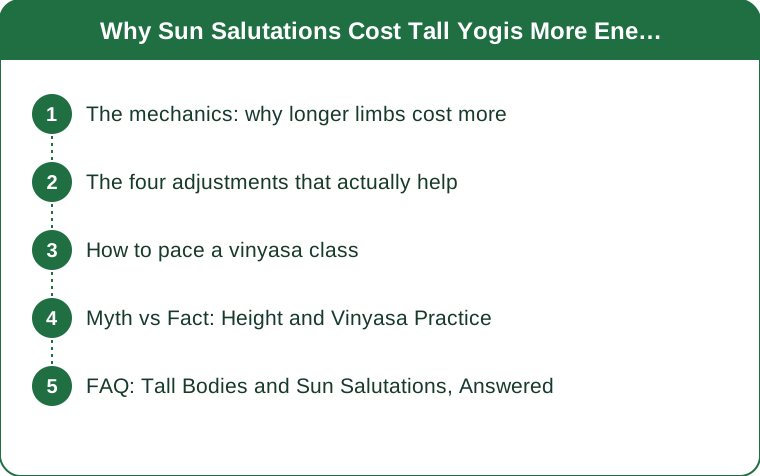
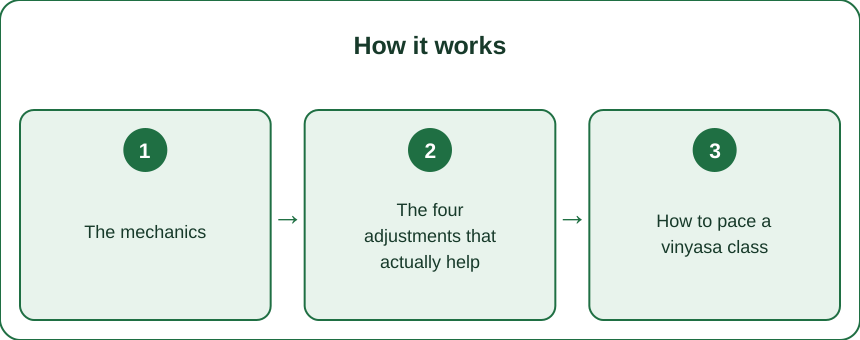
The mechanics: why longer limbs cost more
Every transition moves your limbs through an arc, and a longer limb travels a longer arc for the same movement. Reaching overhead from standing covers substantially more distance for someone at 180 cm than at 160.
The work also scales with mass. Longer limbs are heavier limbs, so you are moving more weight through a greater distance on every repetition - the two factors compound rather than add.
Chaturanga is where this bites hardest. A longer body means a longer lever between hands and feet, and the load on the shoulders and trunk in a plank-to-chaturanga transition rises accordingly.
Forward folds involve a longer travel too. Getting your hands to the floor is a greater distance from a taller standing position, and the hamstring range required is proportionally greater.
Jump-backs and jump-throughs are disproportionately harder. They require lifting a longer, heavier body through a narrow window between the arms - which is why tall practitioners often find them genuinely difficult rather than merely untrained.
The cumulative effect is what matters. One sun salutation is a small difference. Ten in sequence, at class pace, is a real one - and it explains a fatigue pattern that many tall yogis assume is a fitness deficit.
It is not a fitness deficit. It is more work, and recognising that changes how you approach a vinyasa class.
The four adjustments that actually help
Take a wider stance in downward dog and in your forward folds. A wider base reduces the range required at the hamstrings and shoulders, and for tall bodies it is a genuine mechanical improvement rather than a compensation.
Step rather than jump, and do it deliberately. Stepping back and forward costs far less energy than jumping for a long body, and there is no hierarchy in which jumping is superior. Choose it as a strategy, not as a fallback.
Bend the knees in forward folds and transitions. Longer hamstrings need more range for the same shape, and a soft knee lets the pelvis tilt properly rather than rounding the lower back.
Modify chaturanga. Lower the knees, or lower only halfway and build from there. A long lever through the shoulders at full extension is a legitimate reason to modify, and shoulder issues in yoga frequently start here.
Use a slightly slower breath count if you can. Where the class allows, taking two breaths in a transition rather than one matches the pace to the distance your limbs are travelling.
Place your hands slightly wider than shoulder width in plank and chaturanga. Wider hands shorten the effective lever, which reduces shoulder load noticeably.
And use a longer mat if you have the option. Standard mats are 173 cm; longer ones exist at 183 to 200 cm, and having your hands and feet actually on the mat changes the grip and confidence of every transition.
How to pace a vinyasa class
Skip a vinyasa between sides rather than pushing through. Most teachers explicitly offer this. Taking child’s pose or a downward dog while others do a full transition is a pacing choice, not a failure.
Front of the room or the back? The back gives space for a longer body and less pressure to match the pace, which for a tall practitioner is usually the better trade.
Arrive early enough to set your mat with space. Tall bodies need more mat and more surrounding room, and a crowded placement means shortening every pose for the whole class.
Warm up the shoulders before class specifically. Long levers mean more shoulder load, and two minutes of shoulder circles and thoracic rotation before the class starts changes the first ten minutes considerably.
Judge intensity by breath, not by matching the room. If you cannot maintain a steady breath, you are working harder than the person next to you at the same pace - which is exactly what this article is about.
Take a proper rest when offered. Tall practitioners often need the full rest, and cutting it short to look capable is how people end a class exhausted rather than restored.
And tell your teacher. A good teacher will offer proportion-appropriate cues once they know, and most cues in yoga are written for average proportions without anyone noticing.
Myth vs Fact: Height and Vinyasa Practice
Myth: if it feels harder, you are less fit. Fact: you are doing more work. Longer, heavier limbs travelling further through every transition is straightforward mechanics, not a fitness gap.
Myth: jumping back is the advanced version and stepping is the beginner one. Fact: stepping is a legitimate choice at any level, and for a long body it is often the more sustainable one across a full class.
Myth: a wider stance means you are less flexible. Fact: a wider stance reduces the range required. For long limbs it is the mechanically appropriate setup, not a modification for the inflexible.
Myth: straight legs in a forward fold are the goal. Fact: the goal is a long spine and a tilting pelvis. Longer hamstrings need more range for the same shape, and a soft knee achieves the actual objective.
Myth: chaturanga should be full every time. Fact: a longer lever loads the shoulders more, and shoulder problems in yoga frequently begin in chaturanga. Modifying is a reasonable long-term strategy, not a temporary one.
Myth: mat size is a preference. Fact: if your hands or feet come off the mat in downward dog, the grip and confidence of every transition changes. For tall practitioners a longer mat is functional equipment.
Myth: keeping pace with the class is the point. Fact: the breath is the point. Matching a pace that costs you more work than it costs the room is how tall practitioners burn out in the first fifteen minutes.
FAQ: Tall Bodies and Sun Salutations, Answered
Why do I fatigue faster than others in the same class?
Longer limbs travel further and weigh more, so each transition is more work. Across ten sun salutations at class pace the difference is real. It is mechanics, not a fitness deficit.
Should I step instead of jumping?
Often, yes. Jump-backs require lifting a longer, heavier body through a narrow window between the arms. Stepping is a legitimate choice at any level and far more sustainable across a full class.
Why is chaturanga so much harder for me?
A longer body means a longer lever between hands and feet, which increases shoulder and trunk load. Placing hands slightly wider than shoulder width shortens the effective lever and helps noticeably.
Is a wider stance a modification?
No - it is the appropriate setup for long limbs. A wider base reduces the range required at the hamstrings and shoulders, which is a mechanical improvement rather than a compromise.
Do I need a longer yoga mat?
If your hands or feet come off the mat in downward dog, yes. Standard mats are 173 cm; longer options run 183 to 200 cm, and full contact changes the grip and confidence of every transition.
Where should I put my mat in a class?
Toward the back, with space around you. Tall bodies need more mat and more surrounding room, and a crowded placement means shortening every pose for the whole hour.
How do I know if I am pushing too hard?
Judge by your breath rather than by the room. If you cannot maintain a steady breath at the class pace, you are working harder than the person next to you for the same sequence. Persistent shoulder pain deserves proper assessment - this is general information, not medical advice.
TL;DR:
- Longer limbs travel further and weigh more, so every transition is more work. Across ten sun salutations that difference is real.
- It is mechanics, not fitness. Recognising that changes how you approach a vinyasa class.
- Four adjustments: wider stance, step rather than jump, soften the knees in folds, modify chaturanga.
- Hands slightly wider than shoulder width in plank and chaturanga shortens the effective lever and cuts shoulder load.
- Longer mat if your hands or feet come off - standard is 173 cm, longer options run 183 to 200 cm.
- Mat toward the back with space around it. A crowded placement shortens every pose for an hour.
- Judge by breath, not by the room. Matching a pace that costs you more is how tall practitioners burn out early.
Skip a vinyasa between sides when you need to - most teachers offer it explicitly. Persistent shoulder pain deserves proper assessment; this is general information, not medical advice.
Keep Reading
This article is for general informational and styling purposes only. Fit, sizing, and product availability may vary.
