Why Tall Women Lose Balance in Standing Poses Faster — and What Actually Fixes It
Quick Answer: A taller body is a longer inverted pendulum with a higher center of mass, which means the same small sway at the ankle produces a much larger movement at the head — and it happens faster. Tall practitioners aren’t less stable by nature; they get less warning time. The fix is to correct earlier and smaller: widen the base where the pose allows, fix the gaze on a point at eye level rather than the floor, and train ankle-level micro-corrections rather than muscling with the hips.
You’re in tree pose next to someone six inches shorter who looks like she could stand there through the entire class. You’re two breaths in and already fighting it. That is not a strength gap.
Why does height make balance harder?
The physics is unusually clean here.
A standing body behaves like an inverted pendulum — a mass balanced above a pivot at the ankle. The taller the pendulum, the longer its natural sway period, but also the greater the horizontal displacement at the top for any given angle at the base.
Concretely: a one-degree tilt at the ankle moves the head about 1.2 inches for a 5’3” body and about 1.4 inches for a 5’11” body. That sounds small. It isn’t, because the corrective force required scales with that displacement, and because the movement is happening while you’re also trying to hold a shape.
Your center of mass sits higher. Roughly 55 to 57 percent of standing height for most adults, so a taller person’s center of mass is physically higher off the ground. Higher center of mass over the same size base of support equals less margin.
And the base of support does not scale with height. Feet get somewhat longer with height, but nowhere near proportionally. A 5’11” woman may have a foot only 10 percent longer than a 5’3” woman while carrying a center of mass 12 percent higher over it. The ratio works against you.
The practical consequence: you get less time between the start of a sway and the point where you need a big correction. The wobble isn’t bigger — it’s faster to become uncorrectable.
What actually helps, in order of effect?
From most to least useful, based on what changes the mechanics rather than the effort.
1. Fix the gaze at eye level, on something that isn’t moving. The single highest-leverage change. Looking down at the floor removes the visual reference that your balance system uses most, and it also drops the head forward, which shifts the center of mass. A point on the wall at eye height, six to ten feet away. Not the mirror — moving reflections are worse than useless.
2. Correct at the ankle, not the hip. Small, continuous adjustments through the foot and ankle are what stable balance actually looks like. Large hip and torso corrections mean the sway got too far before you responded. Spread the toes, feel the four corners of the foot, and let the arch and ankle do quiet work. If your standing hip is swinging, you waited too long.
3. Widen the base where the pose allows. In warrior III, half moon, and standing splits, a slightly wider stance or a hand on a block dramatically increases the margin. This is not cheating — for a longer lever, it’s the equivalent stance.
4. Use the wall or a block deliberately, not apologetically. A fingertip on the wall provides enough sensory feedback to stabilize without doing the work for you. For tall practitioners it’s the difference between practicing the pose and fighting it.
5. Slow the entry. Most balance losses happen during the transition, not the hold. Taking two extra breaths to arrive gives the ankle time to find the position before the load arrives.
What Nobody Tells You About Tall Balance
Barefoot on a thick mat is harder than barefoot on the floor. Cushioned mats absorb and delay the ankle feedback you rely on, and the longer your lever the more that delay costs. Practice balance poses at the edge of the mat or off it entirely. Many tall practitioners report an immediate difference, and it’s the cheapest fix available.
Balance is worse when you’re tired, and it degrades faster for you. Ankle stabilizers fatigue, and the taller pendulum has less tolerance for a slowed correction. Put balance work earlier in a practice rather than at the end.
Your arms are a real tool. Longer arms have more rotational inertia, which means small arm movements generate meaningful corrective torque. Arms out wide in a wobble is not a failure — it’s a physically sound response, and taller practitioners get more out of it than shorter ones.
Tree pose foot placement matters more for you. Foot to the ankle or the inner thigh, never the side of the knee. With a longer lever the sideways force on that knee is greater, so the standard warning applies harder.
Teachers rarely cue for proportion. The instruction “bring your hand to the floor” assumes a torso-to-arm ratio you may not have. A block under the hand isn’t a modification for you, it’s the correct height.
And the one that reframes everything: balance improves substantially with practice at any height. The physics sets your starting difficulty, not your ceiling. Tall dancers and gymnasts are not defying anything — they’ve trained the earlier, smaller correction until it’s automatic.
What should you train off the mat?
Balance responds to specific, boring practice better than to general fitness.
Ankle strength and proprioception, 5 minutes, most days:
- Single-leg stand, eyes open: 30 seconds each side. When that’s easy, do it on a folded towel.
- Single-leg stand, eyes closed: 10 to 20 seconds each side, near a wall. Removing vision forces the ankle and inner ear to do the work, and this is where the biggest gains come from.
- Heel raises, slow: 3 sets of 12, with a 3-second lower. The calf and the small foot muscles do the fine corrections.
- Toe spreads and short-foot drill: press the ball of the foot down while drawing it slightly toward the heel, keeping the toes long. 10 repetitions each side. This activates the arch muscles that most people never consciously use.
Hip stability, twice a week:
- Side-lying leg raises: 3 sets of 15 each side. The gluteus medius keeps the pelvis level in single-leg poses, and a longer lever demands more of it.
- Single-leg deadlift, bodyweight or light: 3 sets of 8 each side. This is the most transferable strength movement for standing balance.
Frequency beats duration. Two minutes daily outperforms fifteen minutes once a week, because balance is a nervous-system skill more than a strength one.
A realistic timeline: most people notice a difference in single-leg poses within two to three weeks of daily practice, with substantial change by eight weeks.
This is general information, not medical advice. If you have a history of ankle injury, vertigo, or inner-ear conditions, work with a professional before doing eyes-closed balance work.
How do you adapt specific poses?
The common standing poses, with the tall-specific adjustment.
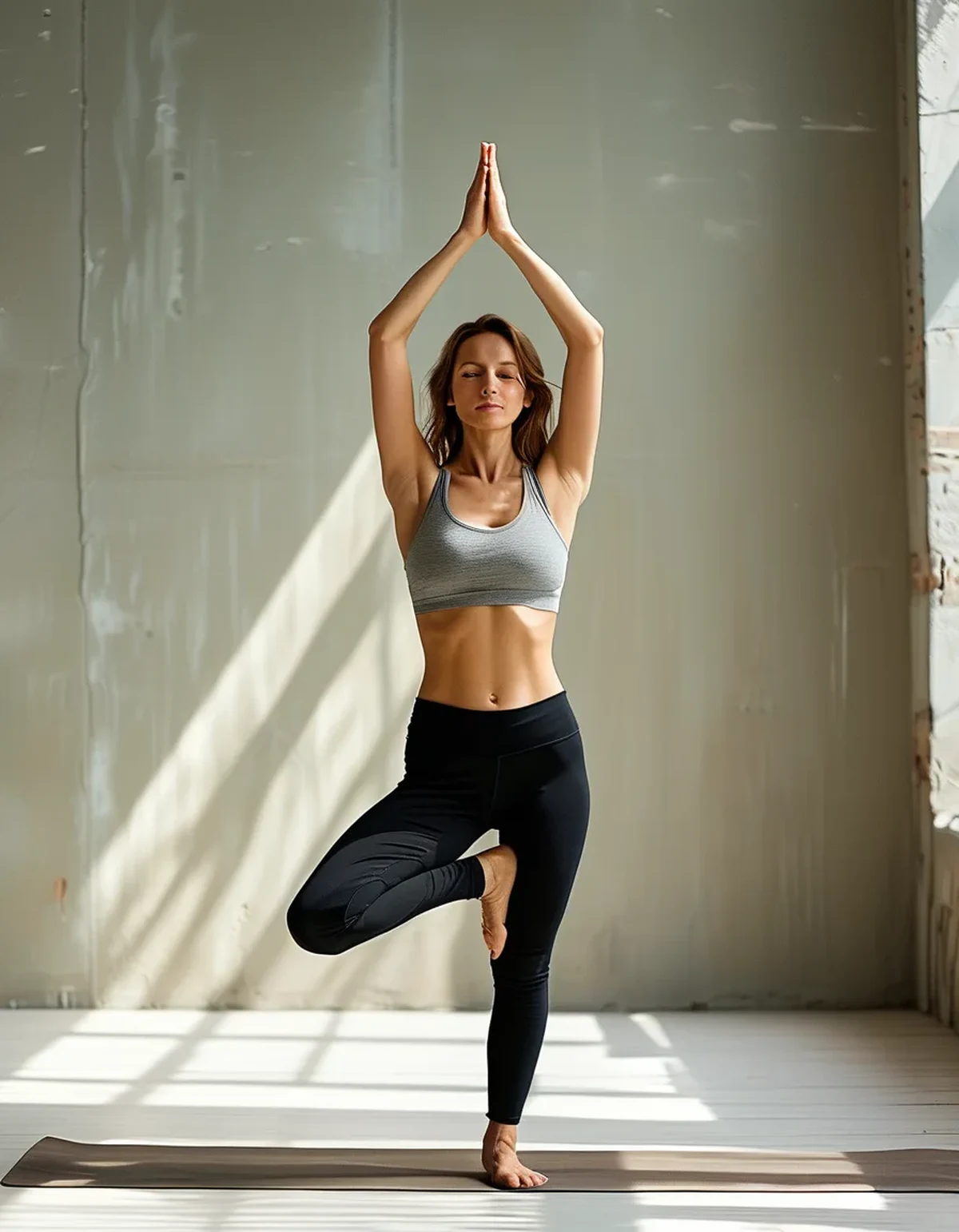
Tree (Vrksasana): Foot at the ankle or inner thigh. Hands at heart rather than overhead until the hold is solid — arms overhead raises the center of mass further, which you can least afford. Gaze at eye level on the wall.
Warrior III: Blocks under both hands at their tallest setting. Standard cues assume you can reach the floor with a level torso; for longer arms and a longer torso, the block height is what makes the pose the intended shape rather than a compromised one.
Half moon: Block under the bottom hand, always. Widen the distance between the standing foot and the block slightly beyond what’s cued — the longer body needs a longer base.
Standing splits: Hands on blocks, and don’t chase height in the lifted leg. The higher the leg, the further the center of mass travels, and for a longer body that gets unstable well before it looks impressive.
Eagle: The double-wrap is often harder with longer limbs, not easier. Crossing without hooking the foot is a legitimate version and it keeps the base wider.
Dancer: Strap on the lifted foot rather than reaching for it. Long femurs make the direct grab a shoulder problem more than a balance problem.
Across all of them: arrive slowly, gaze at eye level, correct at the ankle, and use the wall without embarrassment. The pose is the alignment, not the absence of props.
FAQ: Tall Yoga Balance Questions, Answered
Will my balance ever be as good as a shorter practitioner’s?
In practice, yes — trained balance overwhelms the height disadvantage. The physics means you need more skill to reach the same stability, but that skill is trainable and most people underestimate how quickly it develops with daily short practice.
Should I use a thinner mat?
For balance work specifically, yes. Thick, soft mats delay the ankle feedback that stabilizes you, and the effect is larger for a longer lever. Many tall practitioners use a thicker mat for kneeling work and step off it for standing poses.
Why is my balance worse on one side?
Almost everyone has an asymmetry, usually from a dominant leg and old ankle sprains. It shows up more in tall bodies because the margin is smaller. Train the weaker side first and give it an extra set — the gap usually narrows within a month.
TL;DR:
- Height means a higher center of mass over a base that doesn’t scale, so sway becomes uncorrectable faster.
- Gaze at eye level on a fixed point is the single biggest fix; looking down removes your main visual reference.
- Correct at the ankle with small continuous adjustments — big hip corrections mean you responded too late.
- Practice single-leg stands and short-foot drills for five minutes daily; balance is a nervous-system skill and it responds fast.
You’re not less stable. You just get less warning, and warning time is trainable.
Keep Reading
This article is for general informational and styling purposes only. Fit, sizing, and product availability may vary.
