Why Your Downward Dog Feels Wrong No Matter How You Adjust It
Quick Answer: In downward dog, longer arms and legs create a steeper triangle with more load on the shoulders and wrists. The standard hand placement and mat length were calibrated for average limb proportions. Walking the hands wider, shortening the stance, and bending the knees more than feels acceptable are the three fixes.
You have been told to press the heels down, lengthen the spine, and rotate the upper arms. You do all three and the pose still feels like a wrist workout with a hamstring complaint attached.
This is not a flexibility failure. Your triangle has different dimensions than the one the cue was written for.
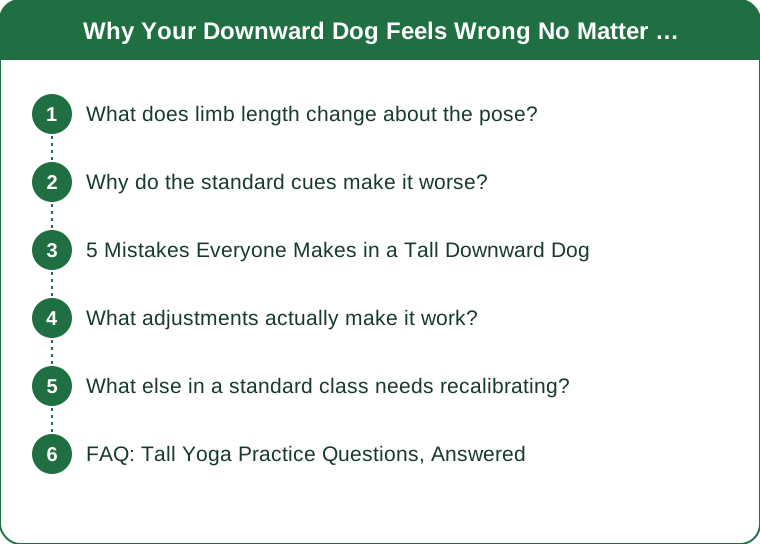
What does limb length change about the pose?
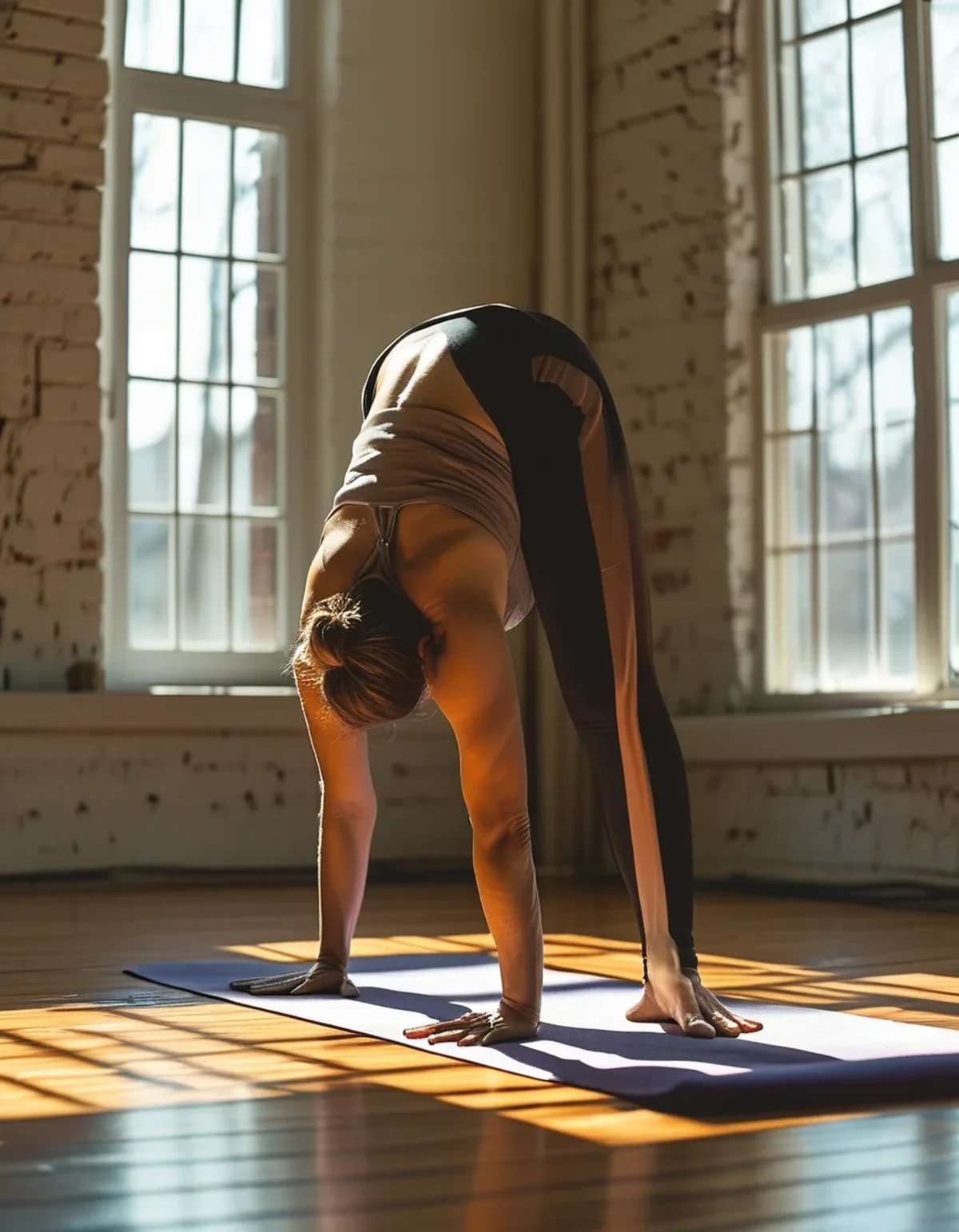
Downward dog is a triangle: your hands and feet are the base, your hips are the apex.
With longer arms and legs, the two sides of that triangle get longer. If you keep the standard hand-to-foot distance — roughly one mat length, which is how most people were taught — the apex has to go higher and further forward to accommodate the extra limb length.
That does two things. It steepens the angle of your torso relative to the floor, which pushes more of your body weight forward onto your hands. And it puts your shoulders further past your wrists, which increases the wrist extension angle.
So the pose becomes disproportionately an arm-loading position for tall practitioners, when it is meant to be roughly balanced between the front and back of the body.
There is a mat problem too: a standard yoga mat is 68 inches long. A practitioner at 5’11” or taller frequently needs more distance than the mat provides, and ends up unconsciously shortening the pose to stay on it.
Why do the standard cues make it worse?
Because several common cues assume a shape you are not producing.
Press the heels down. For a tall practitioner in an already-long stance, this cue pulls the hips backward and down, flattening the triangle further and increasing hamstring tension. The heels reaching the floor is not the goal of the pose and never was.
Straighten the legs. Straight legs in a long stance tilt the pelvis backward, rounding the lower back — the exact opposite of what the pose is for. Bent knees with a neutral pelvis is strictly better.
Hands shoulder-width apart. Wider hands reduce shoulder load meaningfully for anyone with long arms. Shoulder-width is a starting point, not a rule.
Lengthen through the spine. Good intention, but with limbs this long the limiting factor is usually pelvic position, not spinal length. Cueing the spine sends attention to the wrong place.
None of these cues are wrong. They were calibrated for a body of average proportions, and calibration does not travel.
5 Mistakes Everyone Makes in a Tall Downward Dog
1. Staying on the mat. If your hands and feet need more than 68 inches, put your hands on the floor beyond the mat, or turn the mat sideways. The mat is not the pose.
2. Keeping the legs straight to look correct. Bend the knees generously — enough to tilt the pelvis forward and restore the lower back curve. The pose looks less impressive and works far better.
3. Hands too narrow. Move them 2 to 4 inches wider than shoulder-width. Shoulder load drops noticeably.
4. Weight in the heel of the hand. Spread the fingers wide and press through the base of the index finger and thumb. Most wrist pain in tall practitioners is load concentrated at the wrist crease.
5. Treating it as a resting pose. It is a resting pose at average proportions. At long proportions it is a load-bearing arm position, and holding it for 10 breaths repeatedly through a class is a real accumulation. Take child’s pose instead when the sequence offers a rest.
What adjustments actually make it work?
Rebuild the pose from your own proportions rather than from a template.
Find your distance empirically. From plank, walk the feet forward until your hips reach their highest comfortable point with a neutral spine. Mark where the hands and feet are. That distance is yours — it is usually shorter than a full mat length, not longer, because bent knees pull the feet in.
Widen the hands and turn them out slightly. A few degrees of external rotation at the hands relieves wrist strain considerably for long arms.
Use blocks under the hands. This is the single most transformative prop for tall practitioners and almost nobody suggests it. Two blocks at their lowest height reduce wrist extension angle and raise the shoulders out of the deepest part of the load.
Bend the knees until the pelvis tips forward. Find the point where you feel your sitting bones lift and your lower back curve return. Hold there. That is your pose.
Lift the heels freely. Heels down is a hamstring and calf outcome, not a positional requirement. In a long-limbed body it will often never happen, and nothing is lost.
What else in a standard class needs recalibrating?
Downward dog is the most common example, but the same geometry appears elsewhere.
Chaturanga. Longer arms mean a longer lever and more load at the bottom. Lower to the knees without embarrassment, or reduce depth — the elbow-at-90-degrees cue assumes proportions that make it achievable.
Standing forward folds. Long legs plus long spine means your hands are far from the floor. Blocks are not a beginner’s tool here; they are proportional correction.
Low lunge and warrior stances. Standard stance widths will be too narrow. Take a stance that puts your front knee over your ankle at your leg length, which is often a 6 to 10 inch longer step than the person next to you.
Seated forward folds. A longer torso means further to travel. Sitting on a folded blanket to tilt the pelvis forward changes these poses completely.
The general principle: props are proportional adjustment, not assistance. Reframing them that way tends to remove the reluctance, and it is the most useful thing a tall practitioner can internalize.
This is general information, not medical advice. Persistent wrist, shoulder, or back pain in practice is worth discussing with a qualified teacher or clinician.
FAQ: Tall Yoga Practice Questions, Answered
Should I buy a longer mat?
If you practice regularly, yes. Extra-long mats run 72 to 85 inches and remove a constant low-level constraint. It is a one-time purchase that affects every session.
Why does my wrist hurt only in longer classes?
Because load accumulates. Wrist extension under body weight is tolerable briefly and fatiguing over an hour. Blocks under the hands, or fists instead of flat palms in some poses, distribute it differently.
Do tall people have an advantage anywhere in yoga?
Yes — long limbs create genuinely beautiful lines in extended poses, and the leverage helps in arm balances more than people expect. Crow and side crow are often easier, not harder, once the technique clicks.
TL;DR:
- Longer limbs make downward dog a steeper triangle, shifting load onto wrists and shoulders.
- Standard cues — heels down, straight legs, shoulder-width hands — were calibrated for average proportions.
- Widen the hands, bend the knees until the pelvis tips forward, and use blocks under the hands.
- Treat props as proportional correction rather than assistance, and recalibrate stances across the whole practice.
Downward dog has probably felt wrong because you have been performing someone else’s geometry. Build the triangle from your own measurements and it turns back into the pose it was supposed to be.
Keep Reading
This article is for general informational and styling purposes only. Fit, sizing, and product availability may vary.
